Chasing Light in Montreal: A Photographer's Tale
Let me be upfront about something: carrying a medium-format camera through a city is either an act of deep artistic commitment or complete madness. After three days wandering Montreal in peak fall colour, I'm genuinely not sure which one applies to me. What I do know is that this city — with its European bones, Canadian warmth, and frankly unreasonable autumn foliage — gave the GFX 100 II and me more than we bargained for.
This is the story of three days, one very heavy tripod, and a city that photographs itself if you show up and pay attention.
Home Base
Crashed at the Holiday Inn Downtown Montreal - pretty fancy, but hey, they didn't judge me for coming back covered in dew at 5 AM after sunrise shoots. Plus, the location was perfect for my "I forgot something in my room again" moments.
Day 1 — The Lachine Canal: Where Autumn Shows Up and So Do the Birds
Montreal in October was always going to be a good idea. The city sits right in that sweet spot where autumn colour peaks just as the tourist crowds thin out — fewer queues, cheaper hotels, and the kind of crisp air that makes a long walk with a camera feel like exactly the right way to spend a morning. So Day 1 started at the Lachine Canal, which turned out to be a better call than I'd even anticipated.
I set off from near the Charlevoix Bridge, camera bag on one shoulder and the GFX 100 II with the GF 45-100mm f/4 on the other — which, combined, weigh roughly the same as a small child. The canal path is a dedicated cycling and walking trail that runs along the water's edge, and in mid-October it offers a rather impressive spread of colours as the trees along the bank go through their autumn routines at their own individual pace. Some were still fully green, others had turned a deep yellow, and a few maples had gone full scarlet — all of which makes for a nice compositional challenge as you try to balance the warm tones of the foliage against the grey overcast sky and the dark still water of the canal.
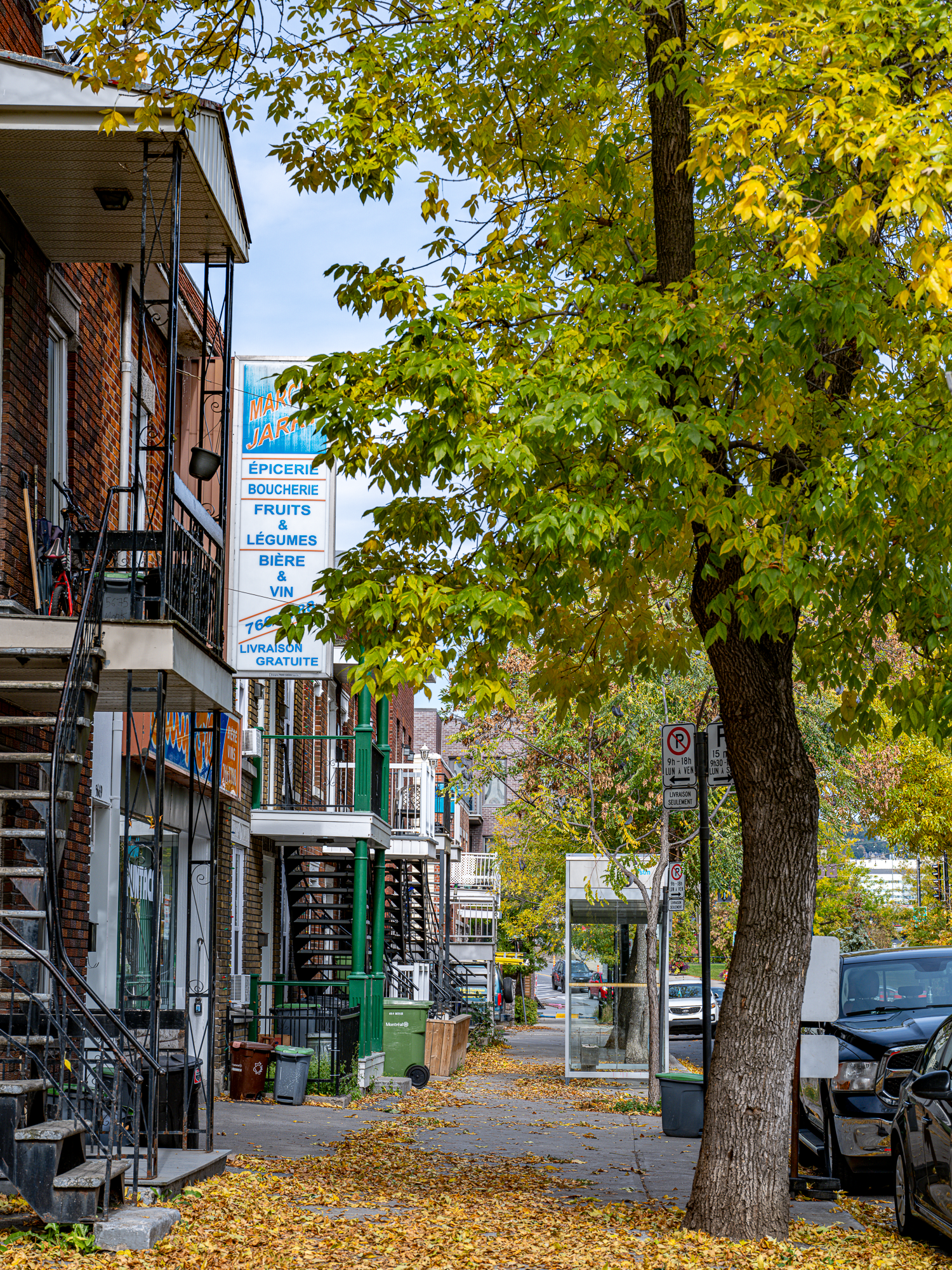


The industrial backdrop on the far bank is something you either work with or ignore, and I found myself leaning into it. There's something genuinely interesting about autumn colour reflected in the canal with a concrete retaining wall and a warehouse sitting behind it — it's not a postcard scene, but it's honest, and it's very Montreal. The GFX sensor handles that kind of tonal contrast well; the highlights in the foliage and the shadows in the dark water can be a tricky exposure balance, but shooting under flat overcast light kept things manageable.

Maple Tree along the Lachine Canal, Montreal
About halfway along the path I had a rather enjoyable unplanned stop. A gentleman with binoculars the size of a small telescope — a serious bird watcher — struck up a conversation and proceeded to give me a remarkably detailed briefing on the bird life along the canal. I nodded along with the confidence of someone who was definitely going to remember all of it and absolutely did not. What I do know is that the canal is a proper migratory stopover and apparently a well-known spot among birders, which explains the steady trickle of people peering into the trees with optical equipment that made even my setup look modest.


I also had Leon, my videographer, along for the trip — he was capturing footage for the YouTube channel while I focused on stills. Having a dedicated person on video makes a real difference; instead of constantly switching between modes and losing the moment, I could stay in the stills mindset and let Leon do his thing. That said, two people with serious camera equipment on a shared cycling path does tend to attract a certain amount of attention from passing cyclists. We were tolerated. Mostly.
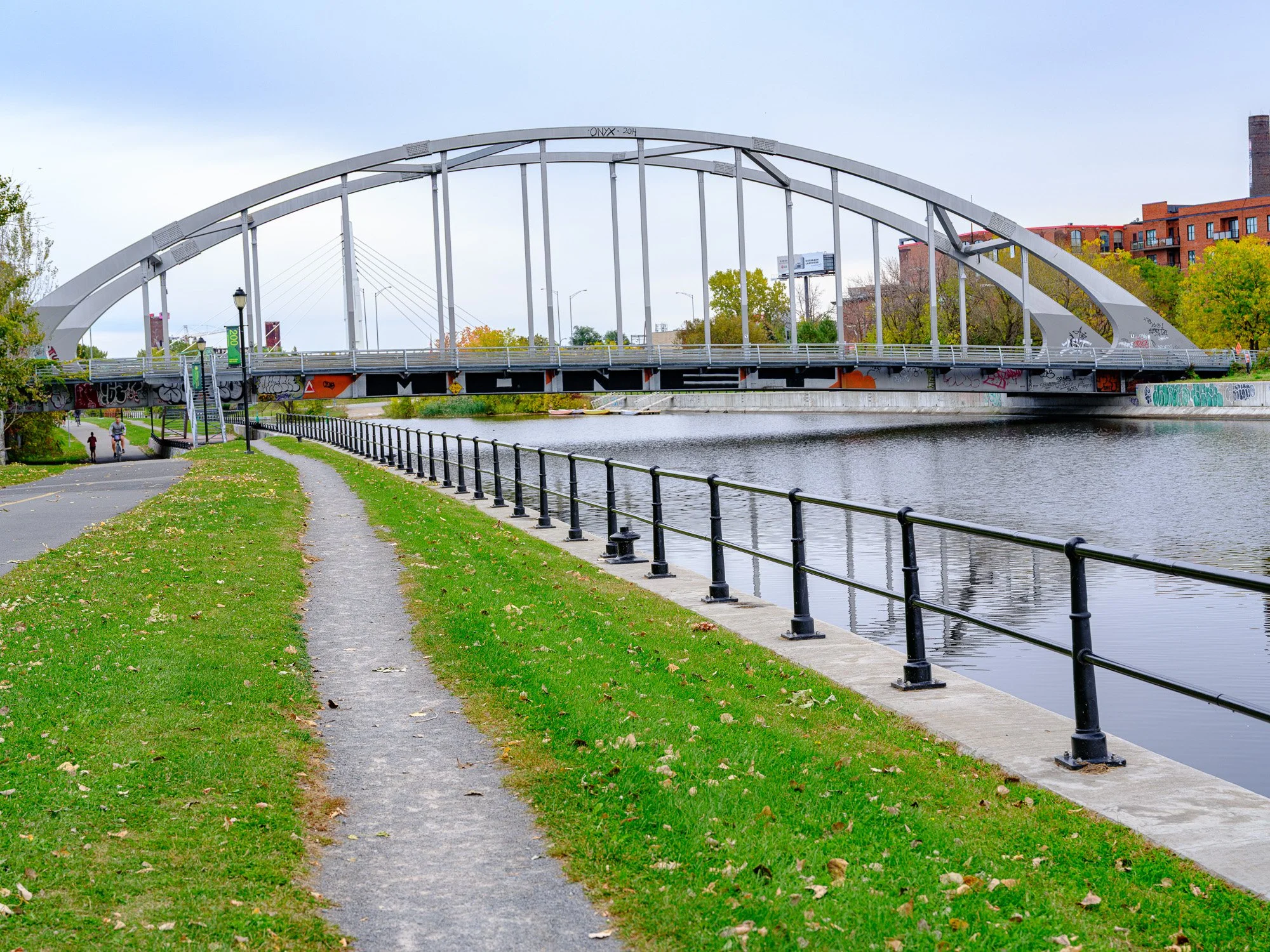
The path opens up beautifully as you get further along — the silver-barked trees create natural frames through which the coloured maples further back pop nicely, and the canal curves just enough to give you leading lines worth working with. The arch bridge framing the Oratory dome in the distance was one of those happy discoveries you only find by getting low and slow with a longer focal length. The GF 45-100mm earns its keep on a morning like this.
Day 1, Session 2— Old Montreal: Cobblestones, Cameras and the Hunt for Parking
After a short detour to take in the views from Mont-Royal Park, we made our way to Old Montreal, which sounds straightforward until you factor in that finding parking in Vieux-Montréal with any efficiency is, let's say, character-building. By the time we'd circled enough blocks to have a decent working knowledge of the neighbourhood's one-way street system, we were ready for lunch. A small café sorted that out nicely — sandwiches, a chance to sit down, and a moment to swap the GF 45-100mm for the GF 20-35mm f/4, which was always going to be the right lens for what was coming next.
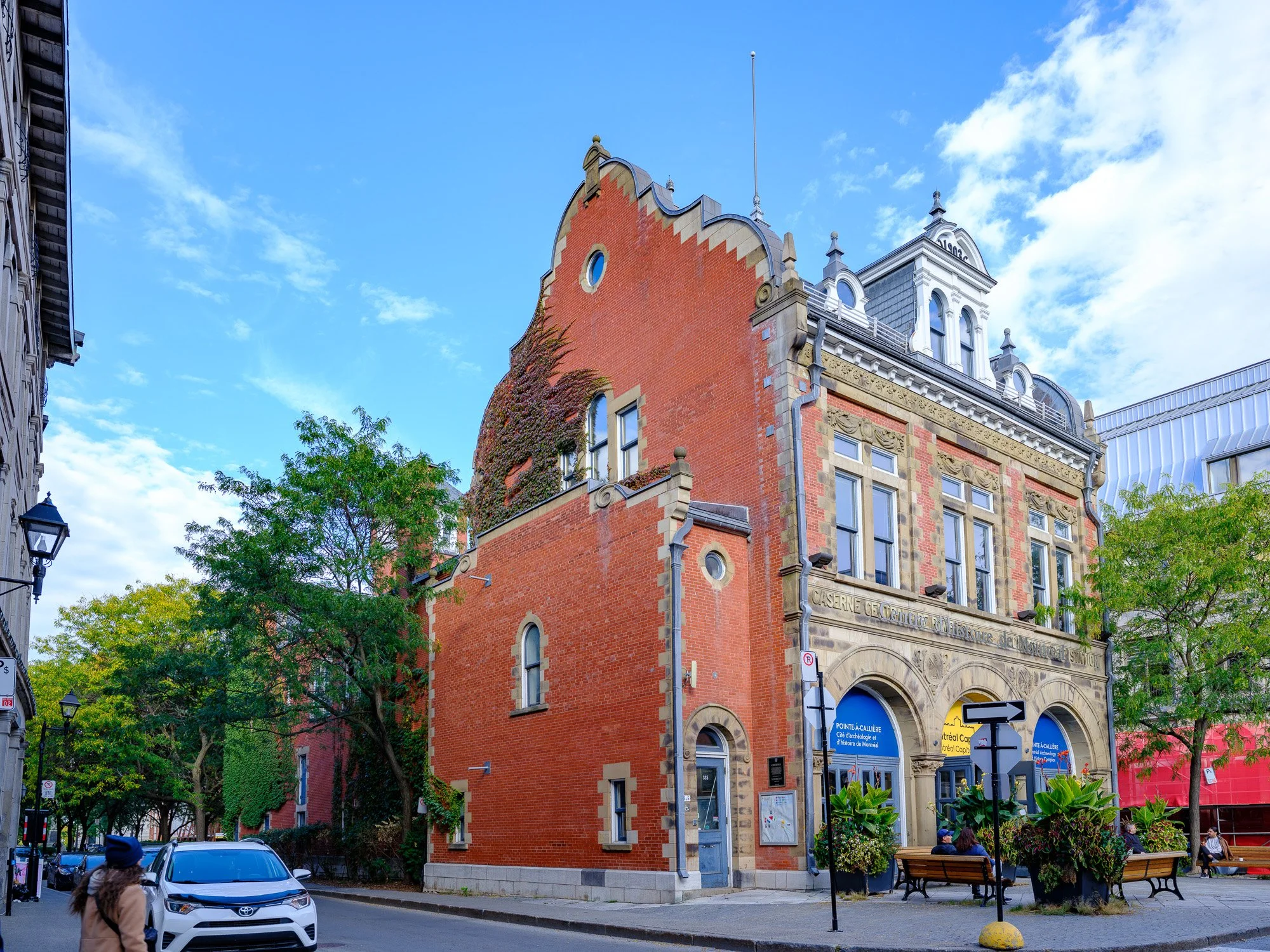
Caserne de Pompiers
The ornate red brick facade of the old Caserne de Pompiers near Pointe-à-Callière, its Dutch-inspired gable draped in autumn ivy against a bright October sky.
GF 100 II, GF 20-35 F4
f/5, 1/160, ISO 200
Old Montreal is one of those places that photographs well, almost regardless of what you point the camera at. The architecture alone is worth the visit — centuries of French colonial, Victorian and Beaux-Arts buildings sitting next to each other with the quiet confidence of a city that knows it has good bones. The old Caserne de Pompiers building near Pointe-à-Callière stopped me in my tracks — that ornate red brick gable with the ivy growing up it against a blue October sky is exactly the kind of thing the 20-35mm was built for. Wide enough to get the full facade in, sharp enough across the frame that the GFX sensor has something real to work with.
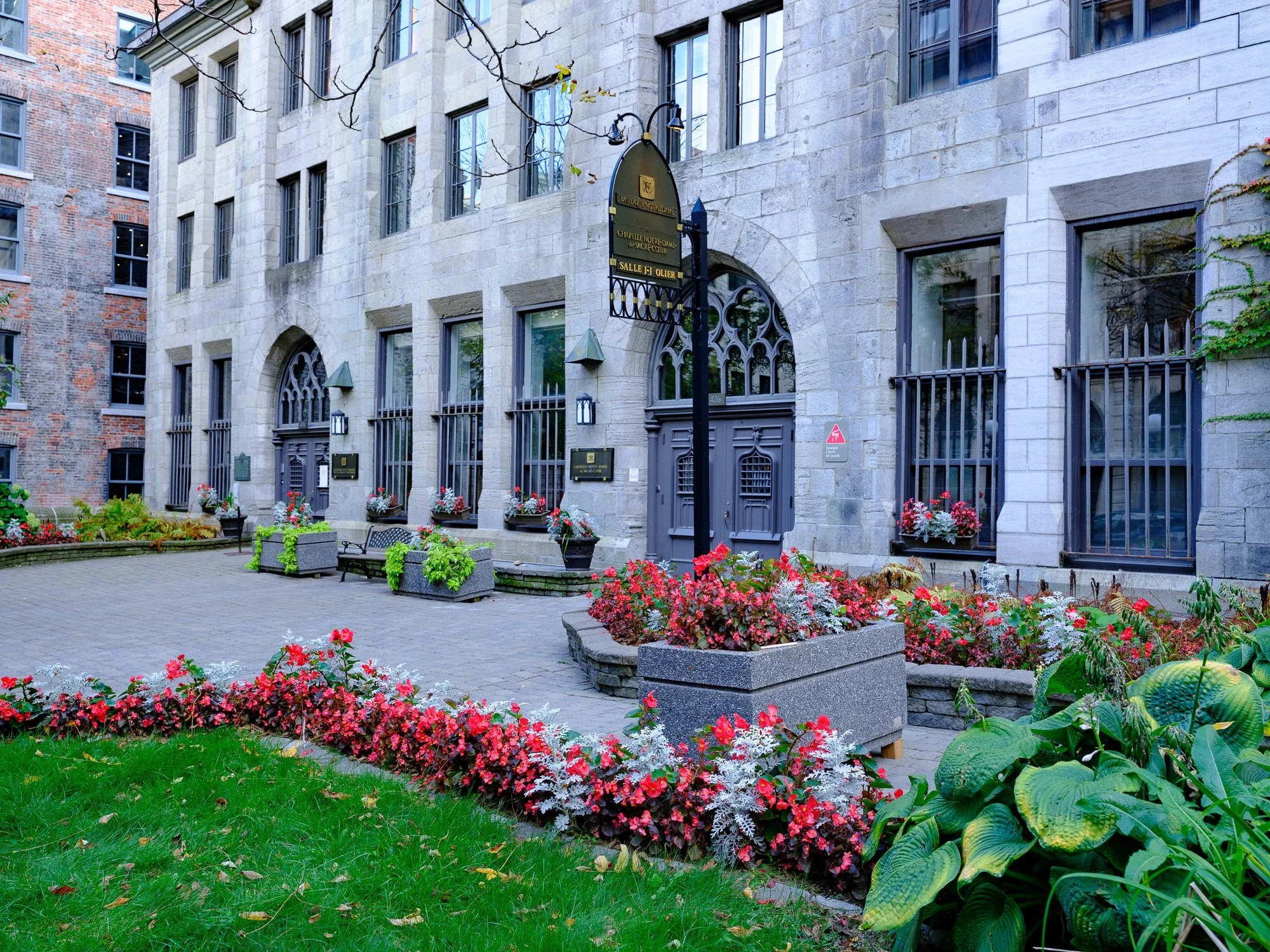
Place d'Armes gave us the Maisonneuve monument framed beautifully through the yellow-green canopy of the square's trees — one of those shots where October does the compositional heavy lifting for you. The Basilique Notre-Dame loomed in the background, as it tends to do, quietly reminding you that this is one of the most photographed intersections in Canada. We worked around the crowds rather than wait for them to clear, which at this time of year is a manageable task — another point in favour of travelling in shoulder season.
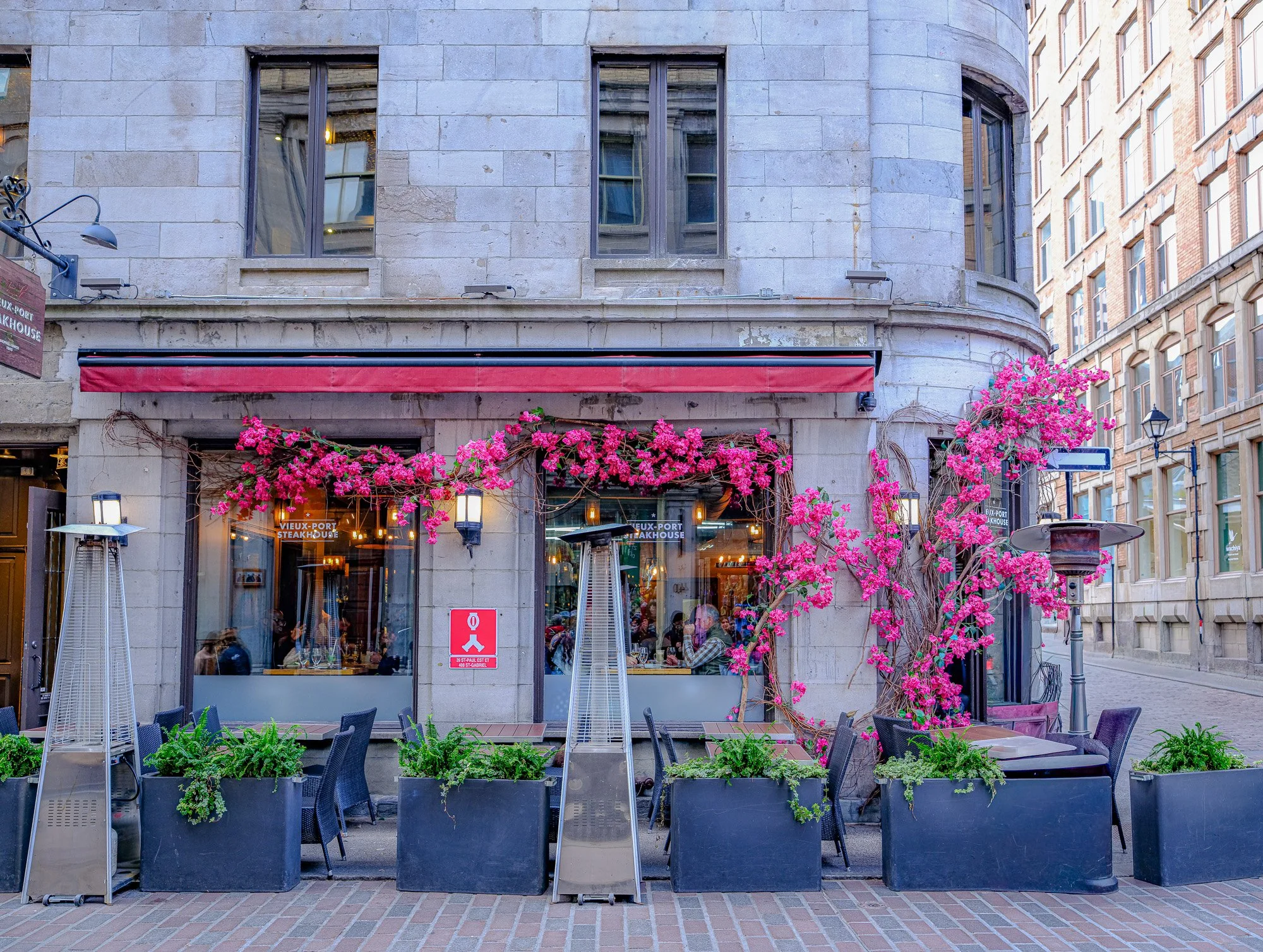
Vieux-Port Steakhouse
The Vieux-Port Steakhouse facade festooned with cascading pink flowers — one of those street photography finds that stops you mid-stride.
GF 100 II, GF 20-35 F4
f5.6, 1/35, ISO 500
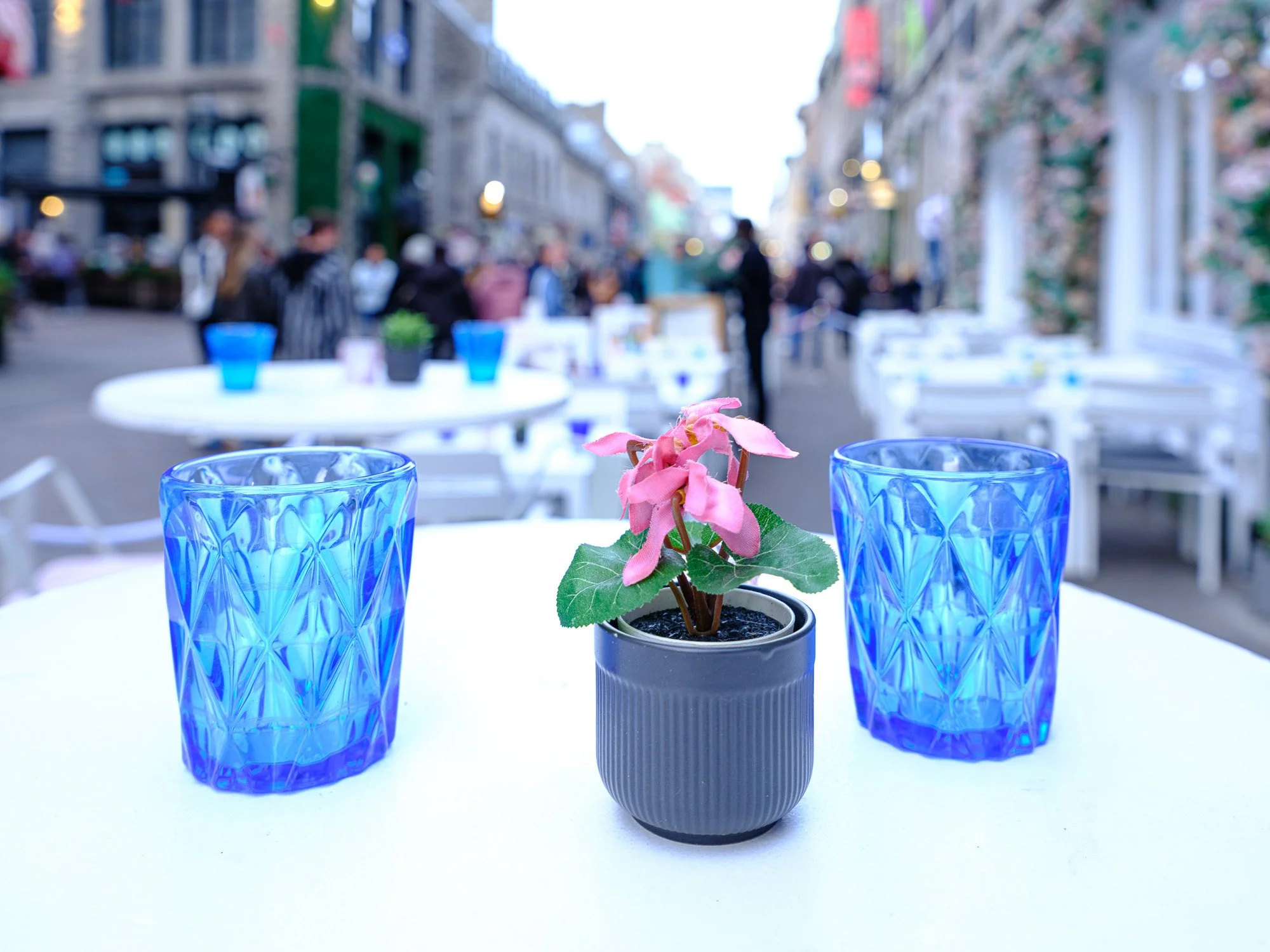
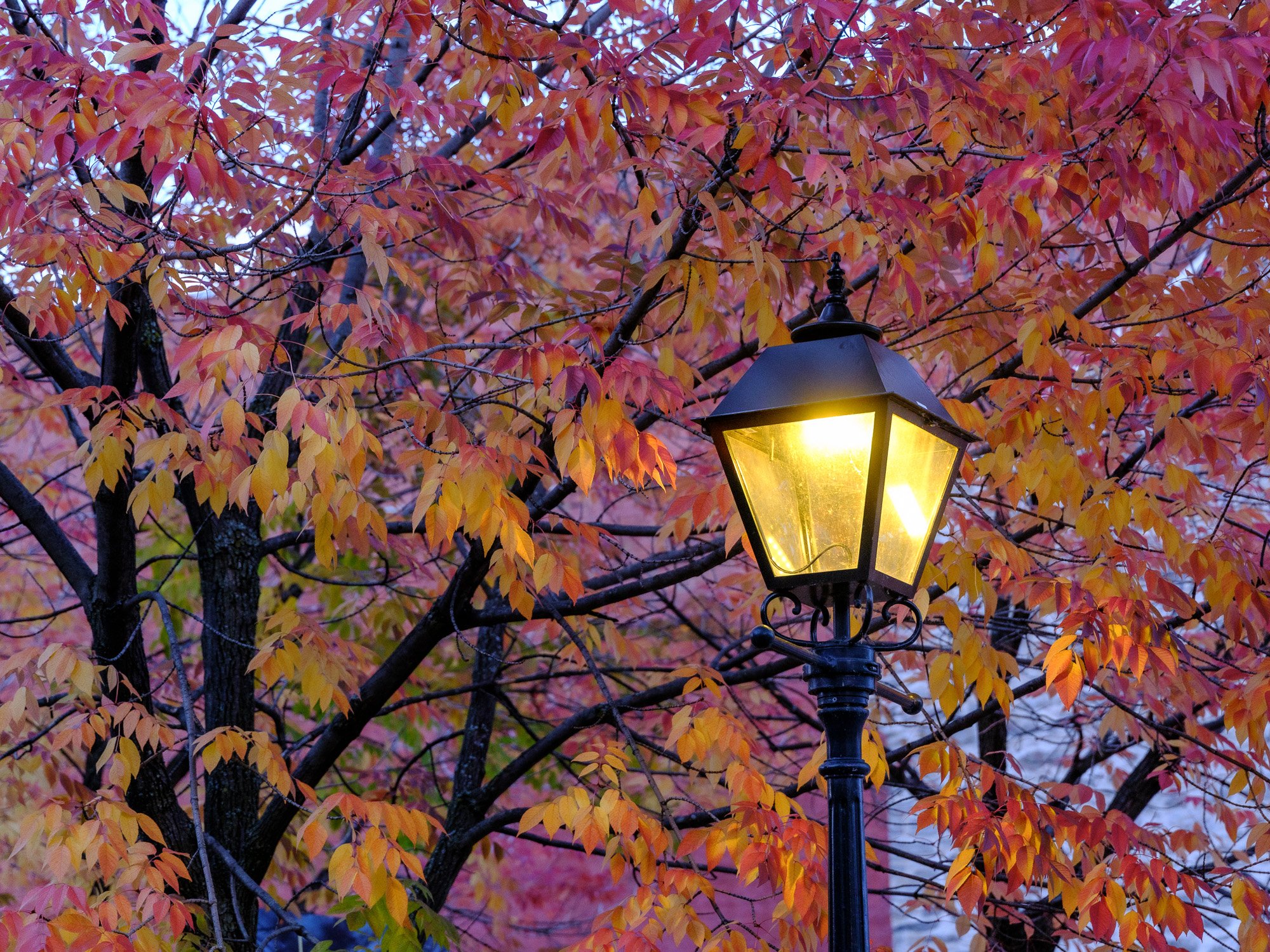
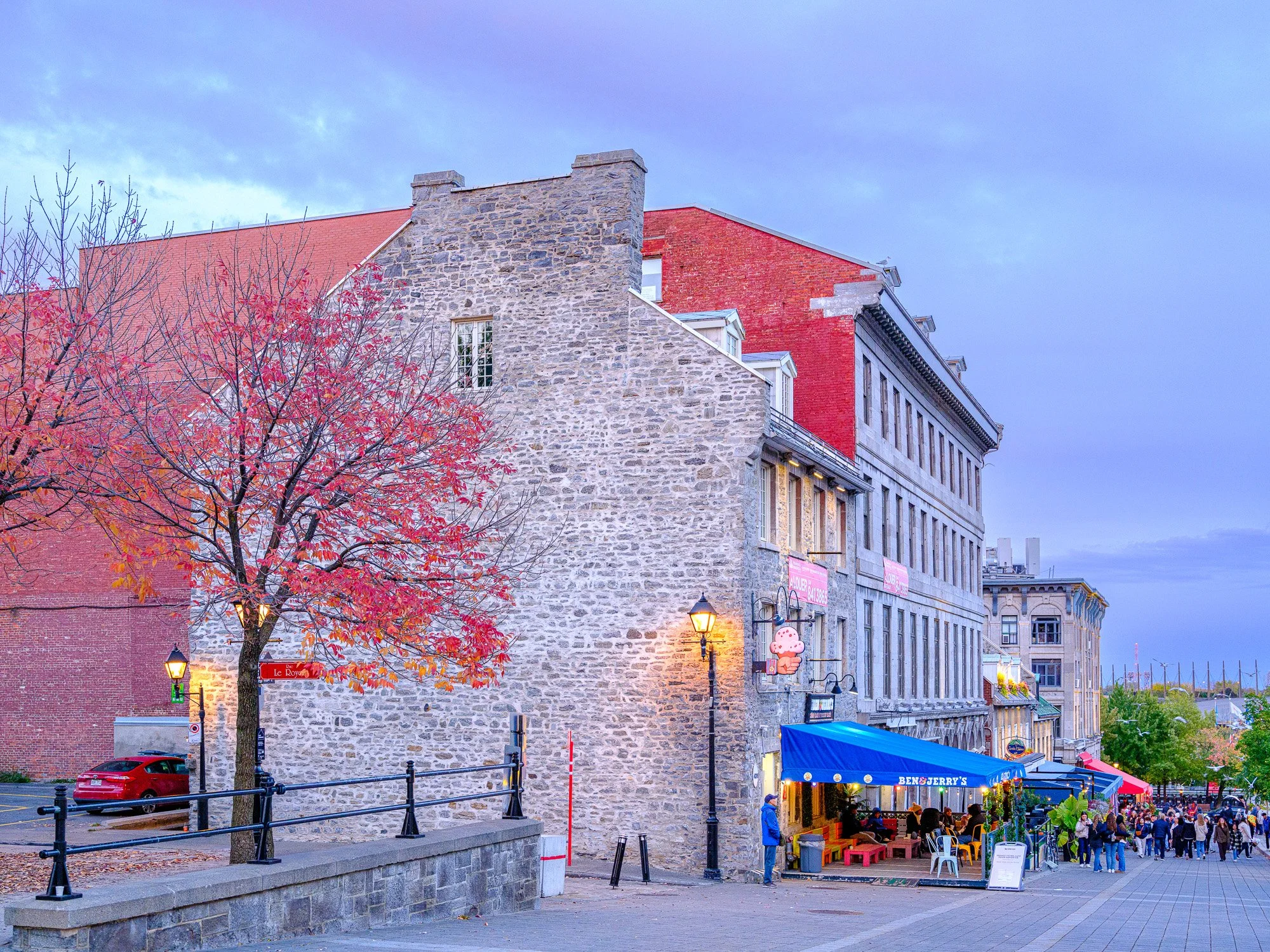
The streets around Rue Saint-Paul and Place Jacques-Cartier are where Old Montreal really earns its reputation. The Vieux-Port Steakhouse facade draped in bright pink flowers was one of those accidental finds that makes street photography worthwhile — the kind of detail you walk past if you're looking at your phone, but stop for when you have a camera in hand. The blue glassware on a café table on one of the pedestrianized streets, the warm glow of the Marché kiosk, the gas lanterns coming on as the light faded — the area has a way of turning itself into a set as evening approaches.
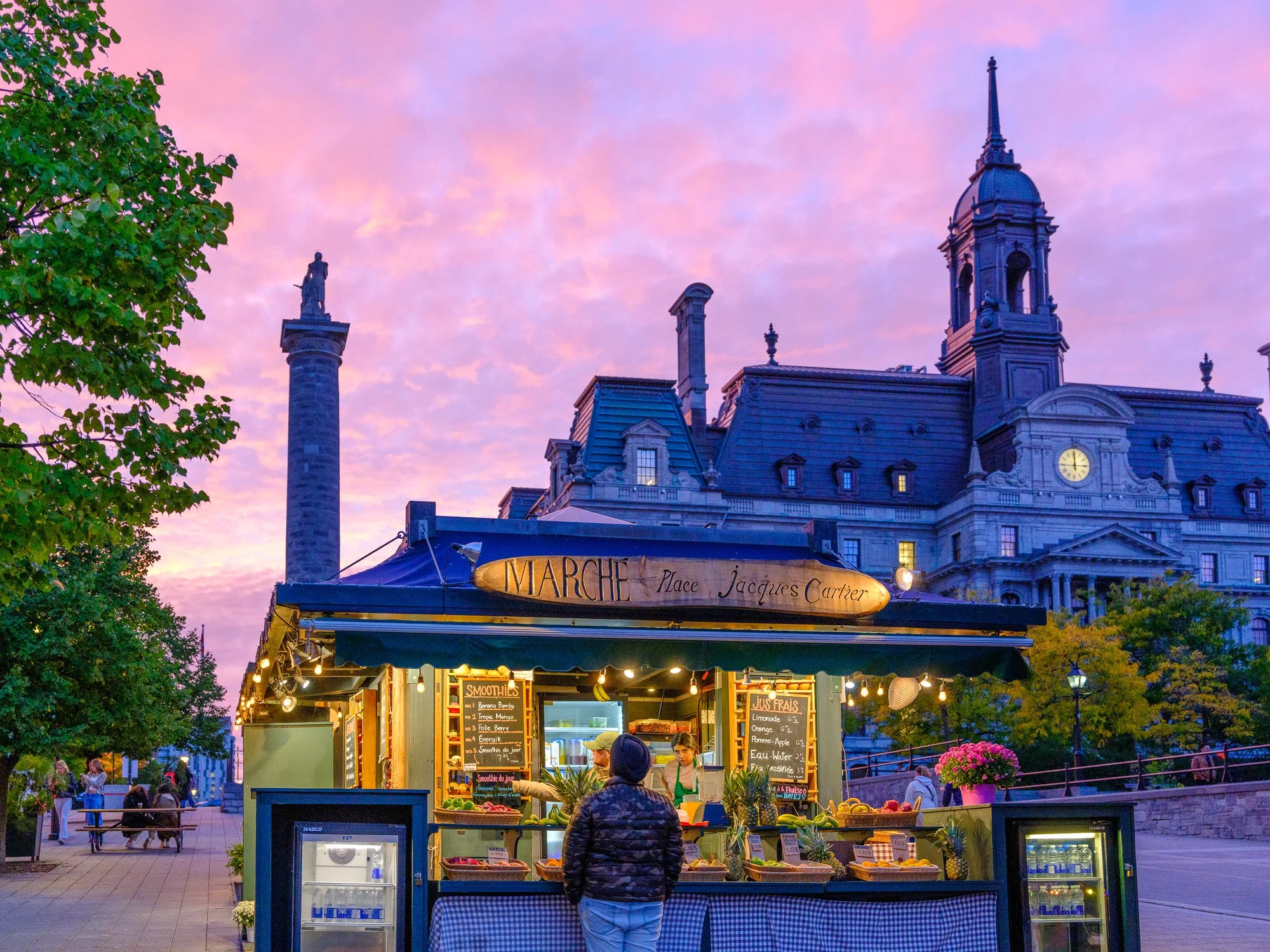
Dusk at Place Jacques-Cartier
The shot of the day: the Marché Place Jacques-Cartier kiosk warmly lit in the foreground, Nelson's Column rising behind it, and the Hôtel de Ville silhouetted against a sky that turned an improbable shade of pink and purple at sunset.
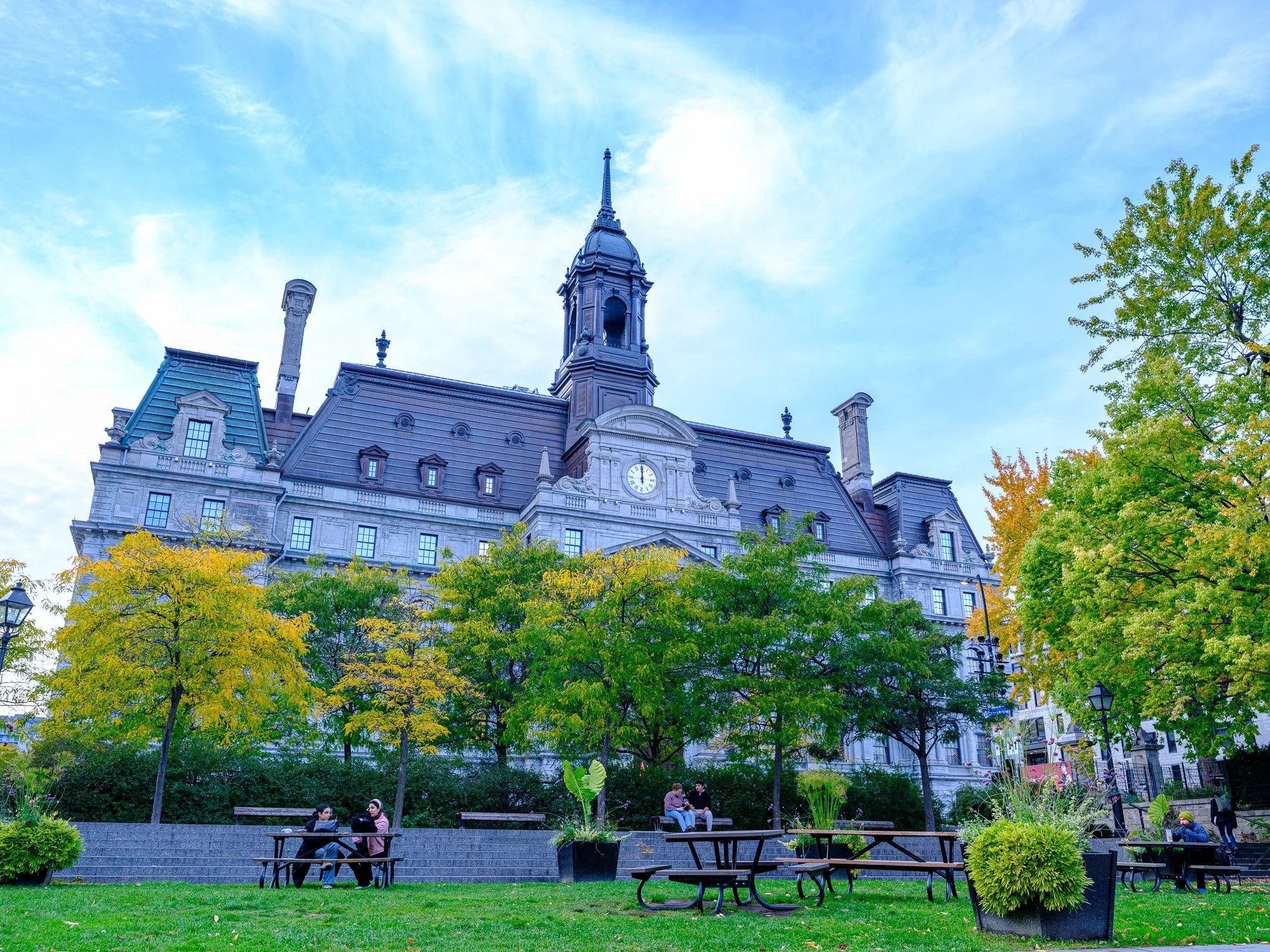
And then the sky happened. That last hour at Place Jacques-Cartier, with the Hôtel de Ville clock tower silhouetted against what can only be described as an aggressively photogenic pink and purple sunset, was one of those moments where you stop worrying about settings and just make sure you don't miss it. The 20-35mm at its widest pulled in the Marché kiosk in the foreground, Nelson's Column in the middle ground, and the whole sky behind — the kind of frame that justifies the entire trip, and makes you briefly forget the parking situation entirely.
Day 2 — Parc du Mont-Royal: Above the City, Among the Maples (and the Rain)
If there's one place in Montreal that autumn treats particularly well, it's Parc du Mont-Royal. Designed by Frederick Law Olmsted — the same man behind New York's Central Park, which tells you something about the ambition involved — the park sits on the hill that gives Montreal its name, and in mid-October, it is running at full capacity in terms of colour. We made our way up to Beaver Lake, the park's central artificial lake, which at this time of year is ringed by maples at or very near peak and reflects the whole spectacle at you on a calm day. It's a straightforward argument for October travel if ever I've seen one.
When I arrived, it was genuinely warm — warm enough that I left my jacket in the car, which felt like a perfectly reasonable decision at the time and would later turn out to be one of the more optimistic calls I've made in recent memory. But more on that shortly.
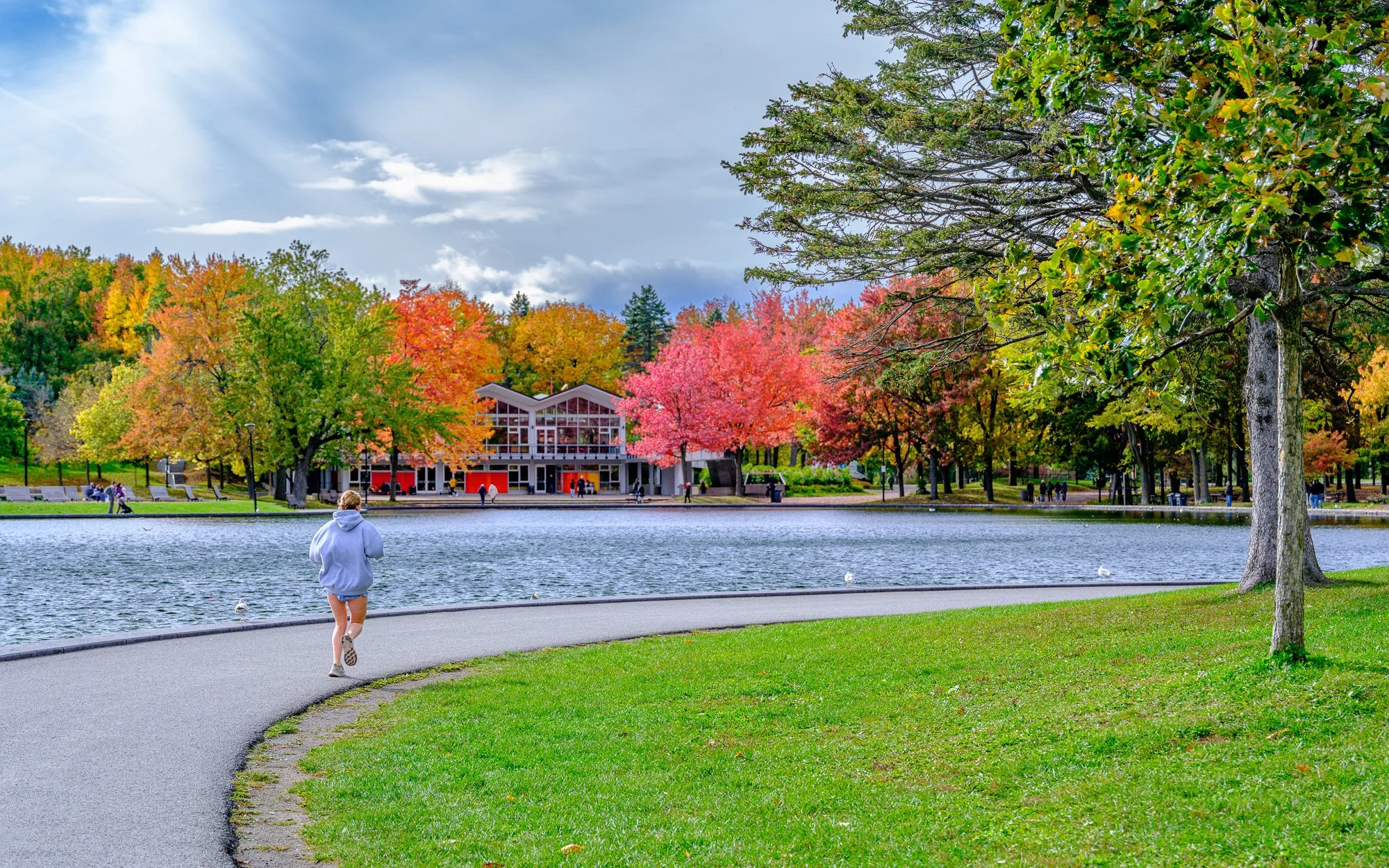
Peak Colour, Beaver Lake - A jogger follows the curved path around Beaver Lake, the Mont-Royal pavilion framed by a blaze of orange and pink maples under a dramatic October sky.
I was shooting with the GFX 100 II, and the combination of big old growth trees, a reflective lake and the kind of bright, warm autumn sunshine that makes you feel like the whole trip was a good idea made for conditions the medium format sensor is genuinely well suited to. The tonal range across a scene like this — deep shadow under the canopy, warm sky above, the amber and orange of the foliage catching the light — is exactly where the extra dynamic range of the GFX pays dividends. Shooting in RAW and exposing carefully for the highlights meant the shadows in the tree trunks came back cleanly in post without any of the noise penalty you'd see on a smaller sensor pushed the same way.
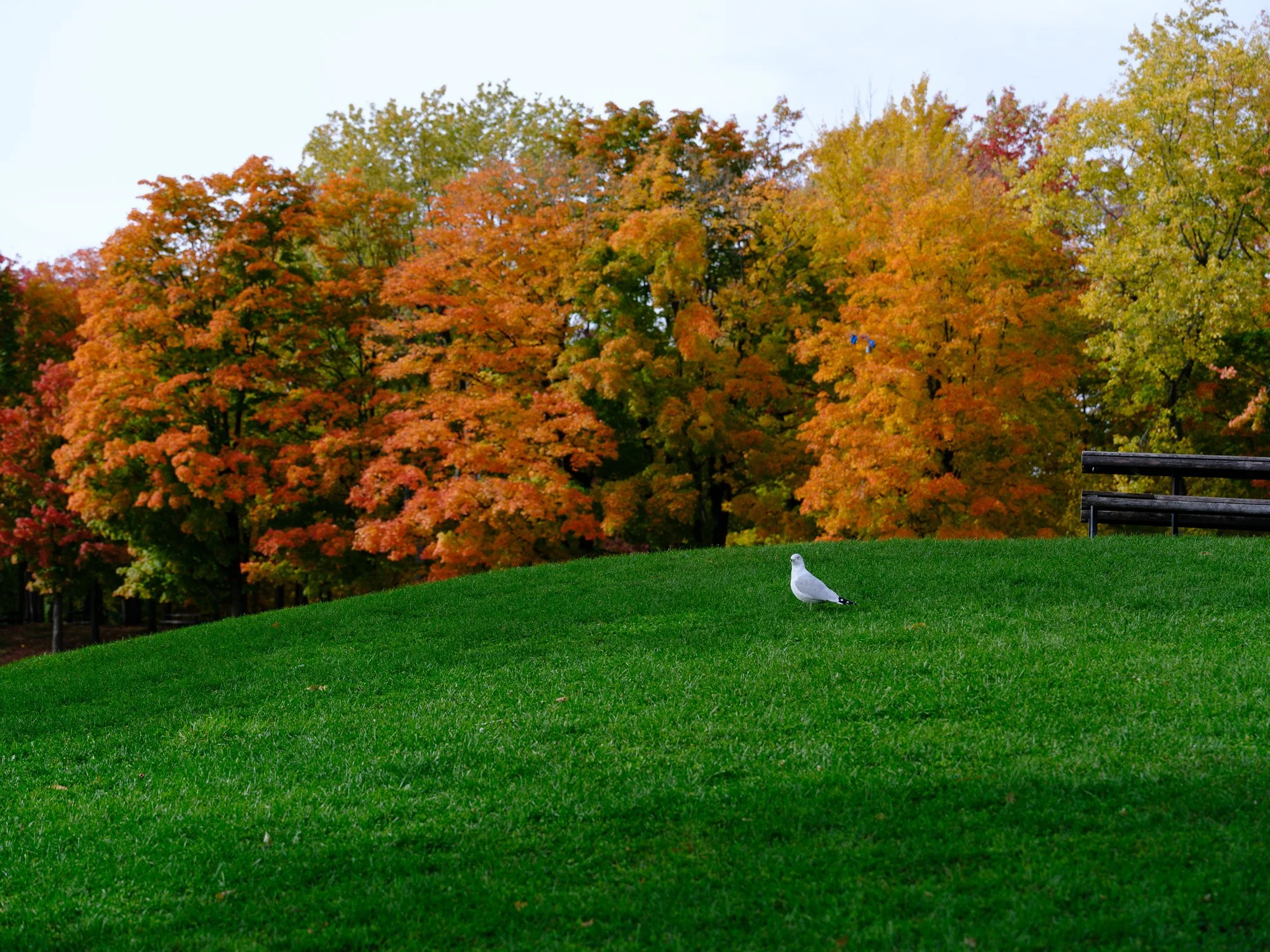
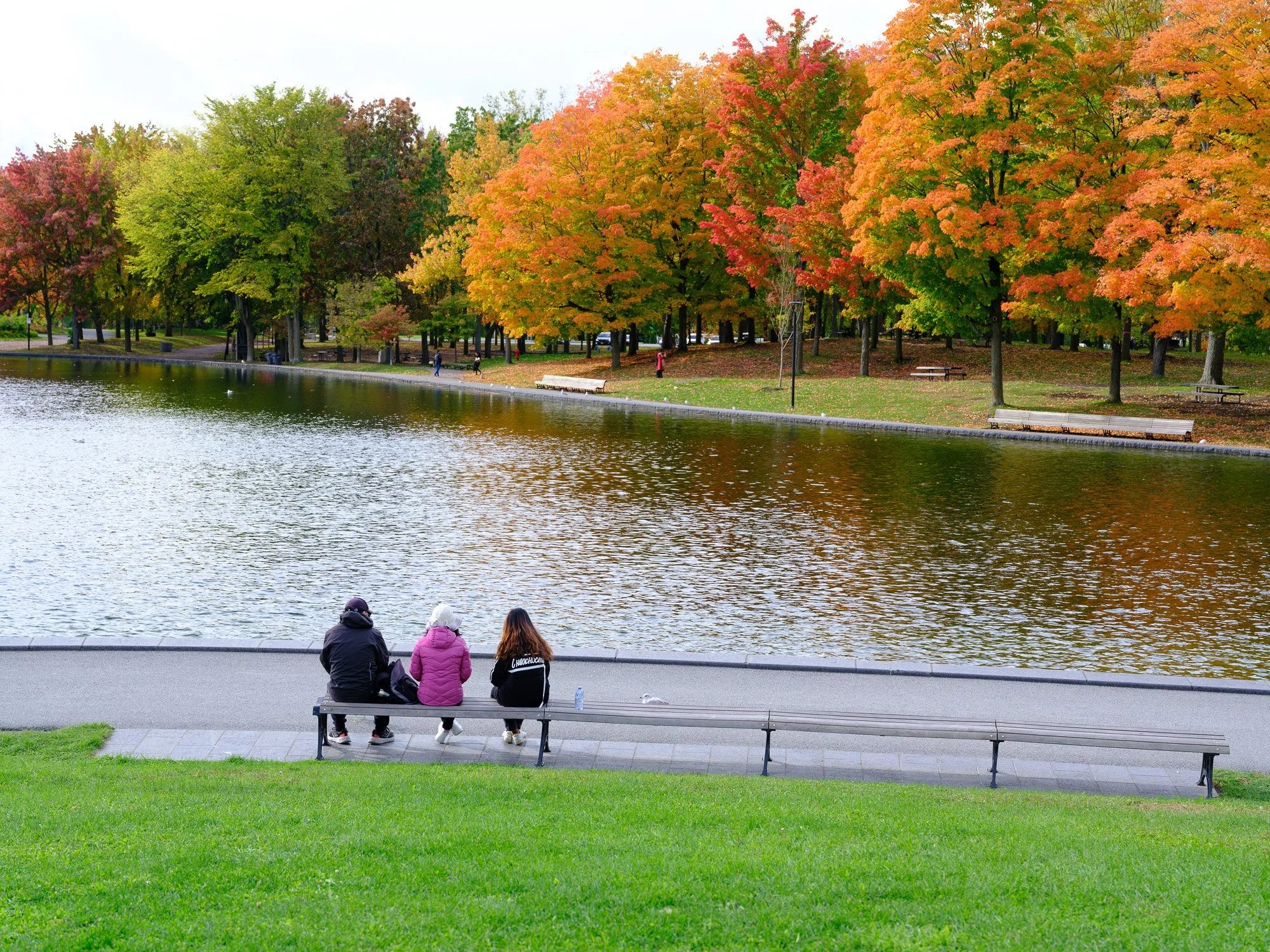
Beaver Lake itself is the natural compositional anchor. The curved path that follows the water's edge gives you a ready-made leading line, and the pavilion on the far bank — framed by a blazing pink maple and surrounded by an orange and yellow canopy — sits there looking almost unreasonably photogenic. The reflections in the lake on the calmer stretches were rich enough that you could almost flip the image and not immediately know which way was up, which is always a good sign.
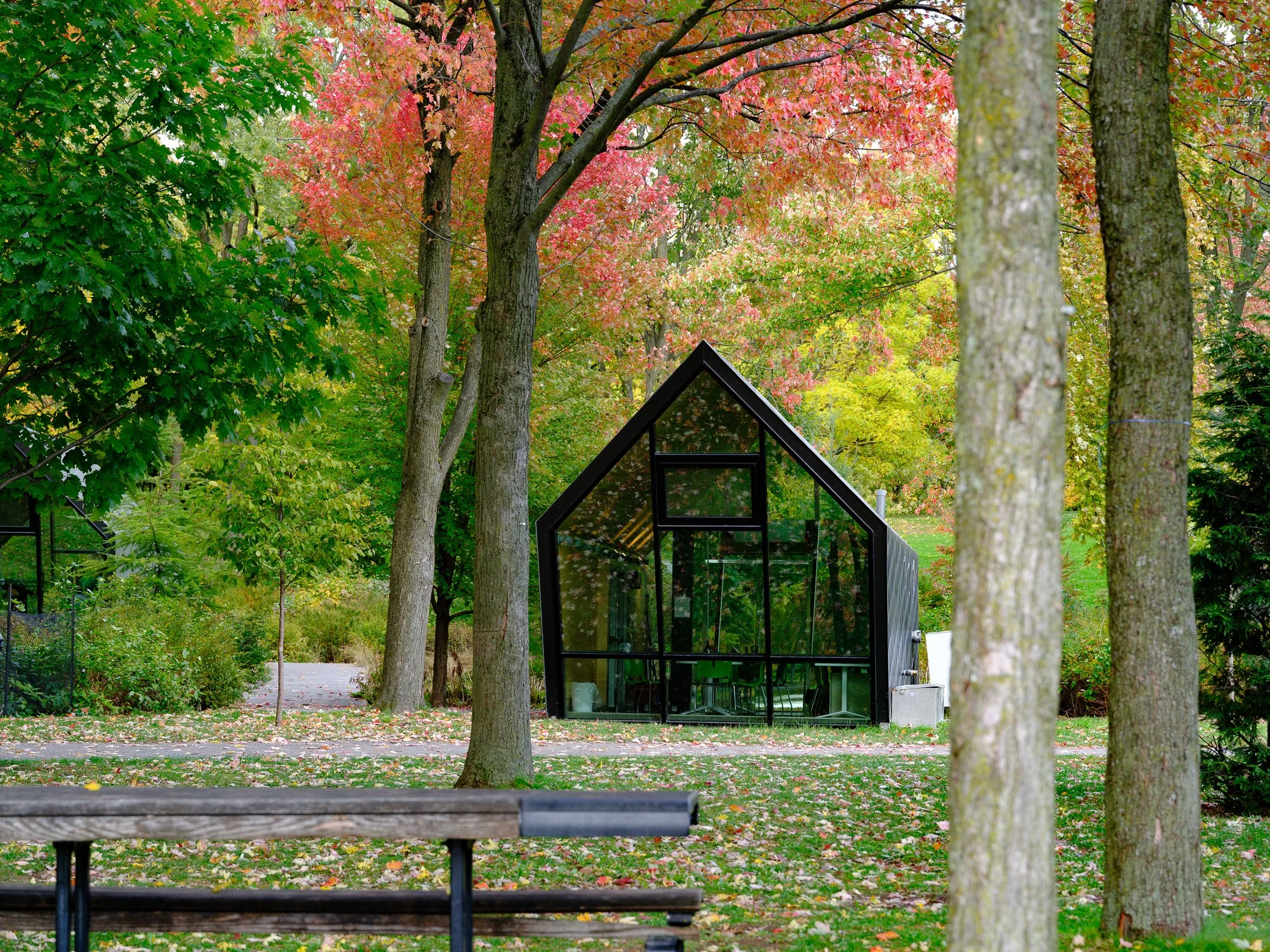
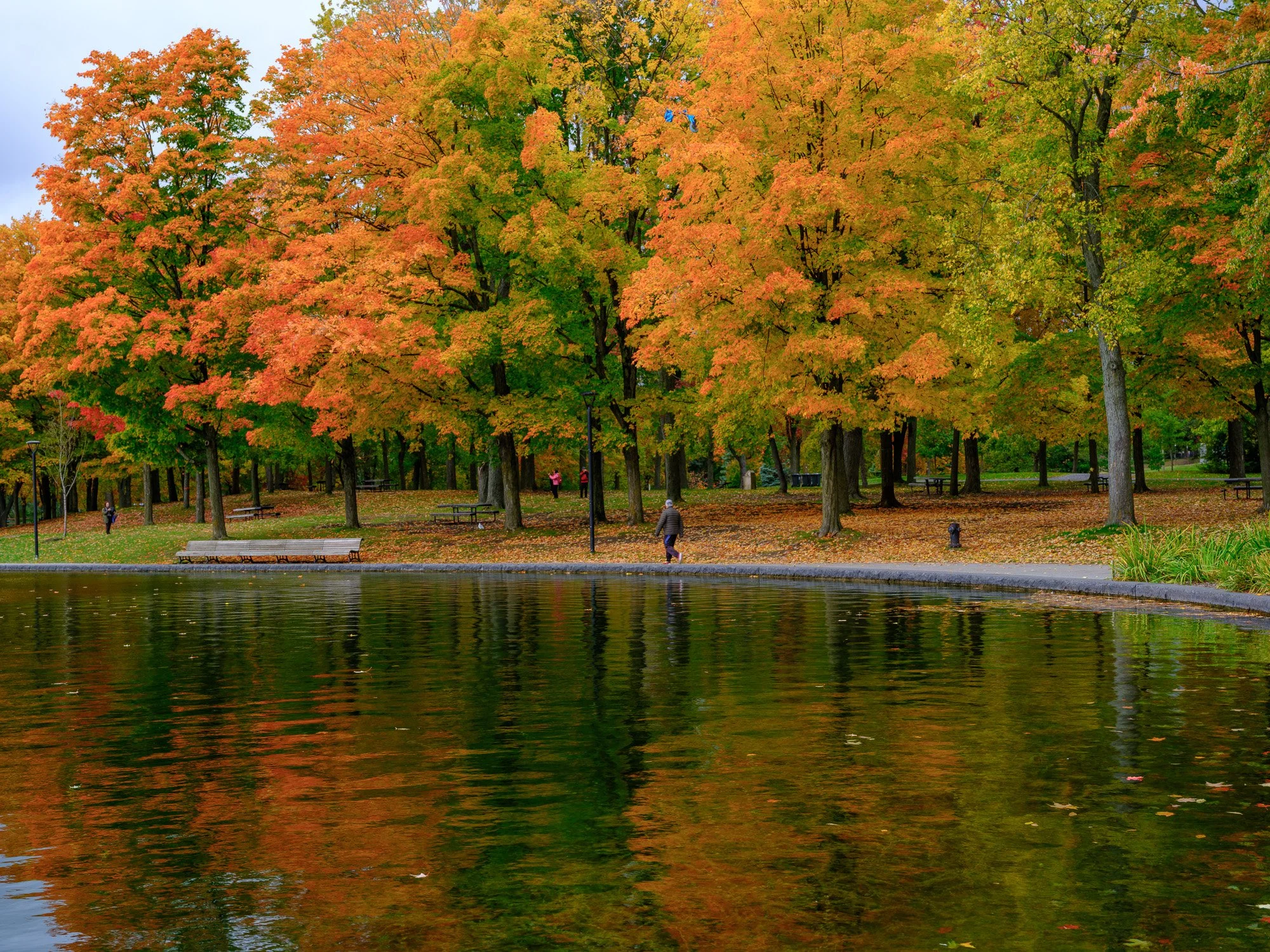
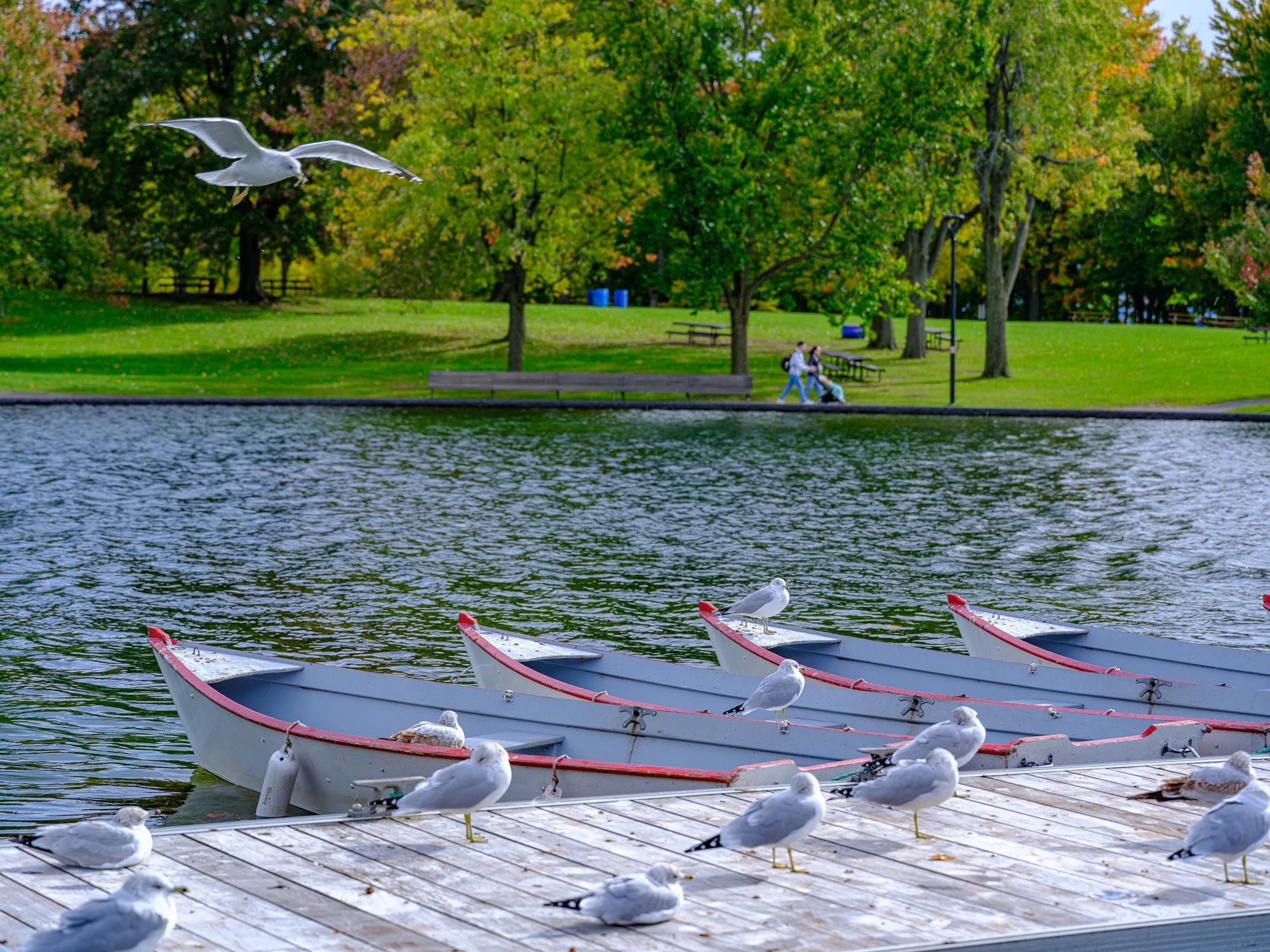
The seagulls had taken full possession of the rowing boats at the dock and looked entirely unbothered about it. One was mid-takeoff as I pressed the shutter — a happy accident rather than any particular skill on my part, but that's often how the best frames happen. A little further into the wooded sections of the park, the old-growth trunks rise from a carpet of fallen leaves in a way that rewards slower, more considered shooting. There's also a striking black steel and glass pavilion tucked into the trees that most people walk straight past. Worth stopping for.
About thirty minutes into the shoot, I noticed something that experienced outdoor photographers learn to read fairly quickly — the light had shifted, the temperature had dropped a couple of degrees, and on the horizon a rather serious-looking storm front was making its way towards us with some purpose. I decided to wrap up and head back to the car. Leon had already left by this point, so it was just me, the tripod, the camera bag and what was shaping up to be a fairly one-sided argument with the weather.
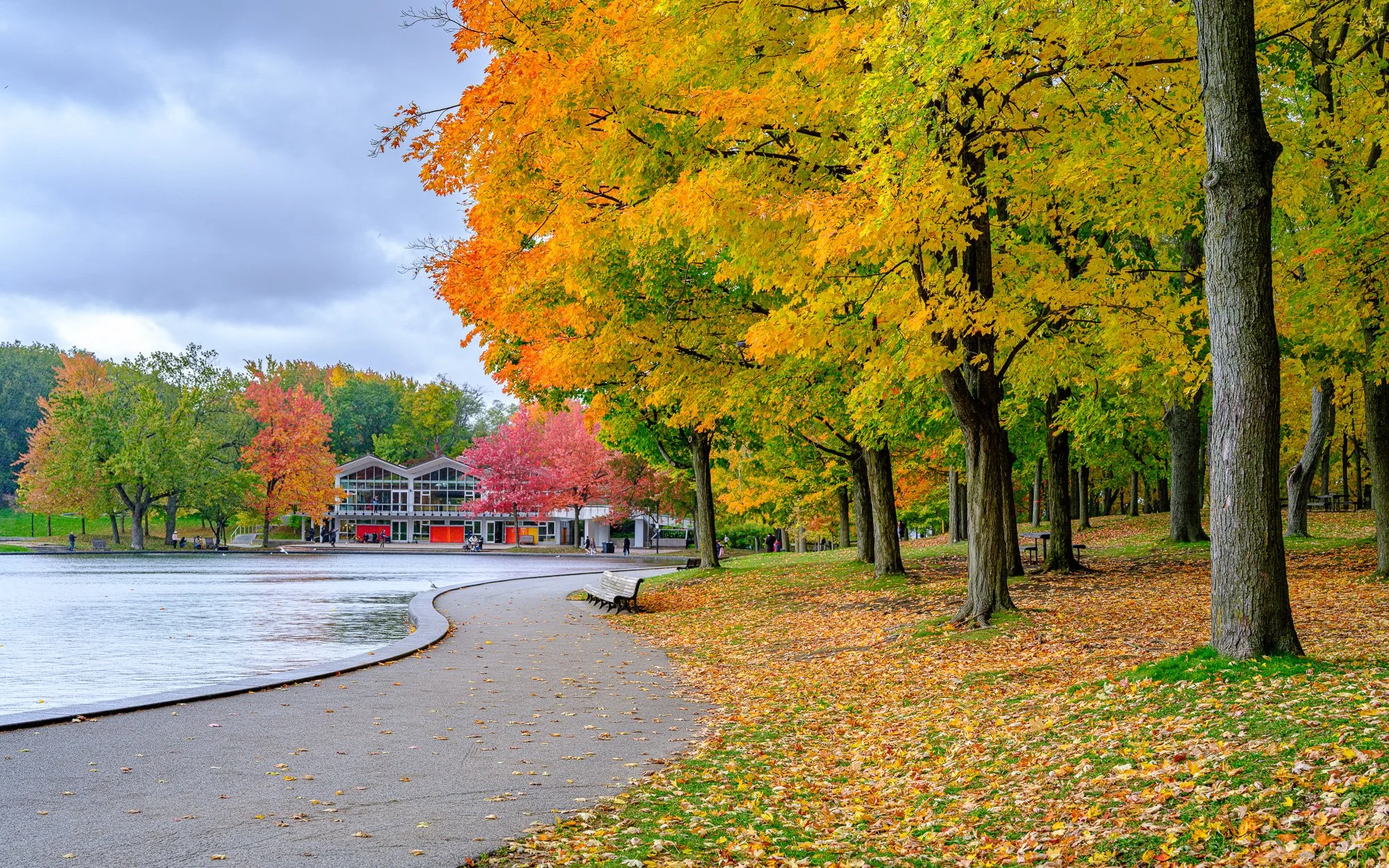
A Walk Worth Taking - The long curve of the Beaver Lake path with the pavilion in the distance, fallen leaves underfoot and the full weight of October in the canopy above
I did not make it to the car.
What followed was a thoroughly comprehensive soaking, delivered by a sudden heavy downpour that arrived considerably faster than I had anticipated and showed absolutely no interest in waiting for me to reach shelter. I got caught halfway back — jacket still in the car, camera bag on one shoulder, tripod on the other — and by the time I made it to the car, I was drenched in the way that requires a full change of clothes and a reassessment of one's life decisions.
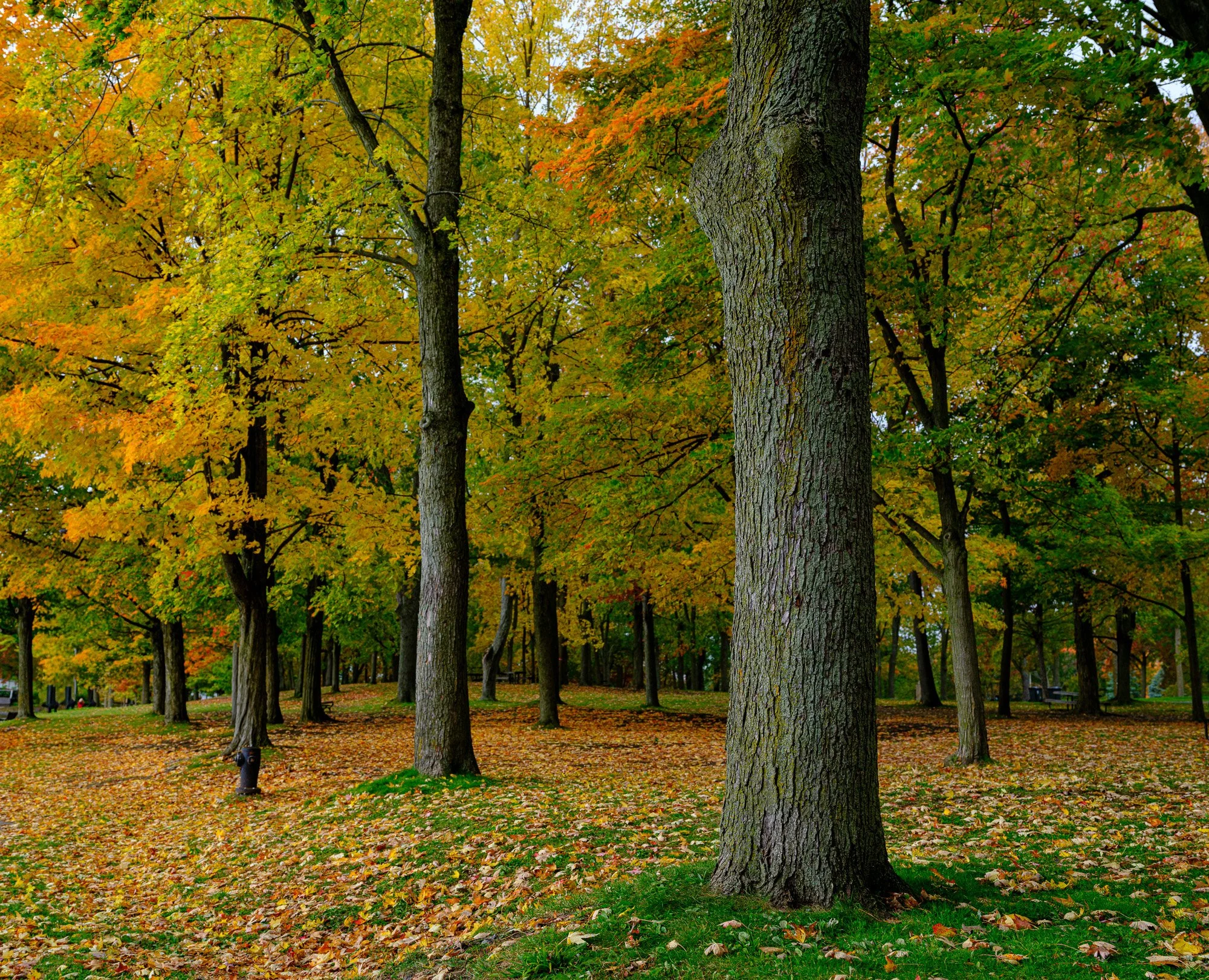
October on the Ground - Old growth maple trunks rising from a carpet of fallen leaves in Parc du Mont-Royal — the forest floor in mid-October, when the park has well and truly let its hair down.
The silver lining — and there was one, literally — was that the GFX 100 II and the GF lenses handled the whole episode without complaint. Weather sealing earns its marketing copy when you're standing in a Montreal downpour muttering at the sky. I got the camera safely into the bag before the worst of it hit. The camera was fine. The photographer was considerably less so. But the images were worth it, and the storm front that chased me out of the park actually gave some of those earlier frames a dramatic, brooding quality to the sky that you simply can't plan for.
Day 3: Downtown Shenanigans
Spent my last day downtown, switching between the GFX and Pocket 3 like a photographer with commitment issues. The Museum of Fine Arts was a nice break - though I kept catching myself pixel-peeping actual paintings (photographer problems).
Wrapped up the day at India Rosa, where I finally gave my camera bag a rest and focused on some serious curry business. Nothing beats ending a photo trip with a food coma!

The Gear I Used For This Trip
Let me tell you about my trusty companions for this trip (and why my chiropractor is now sending me holiday cards):
The beast itself: Fujifilm GFX 100 II
FUJINON GF 45-100mm f/4 R LM OIS WR
DJI Pocket 3 (Because sometimes you need a break from carrying the medium format monster)
Gitzo Series 3 Carbon Fiber Tripod
Arca Swiss C1 Cube Head (The precision tool that costs more than my first car)
Pro Tips — Shooting Montreal in Autumn
1. Time your visit for mid-October
The colour across all three locations — the Lachine Canal, Old Montreal and Parc du Mont-Royal — was at or very near peak in mid-October. Too early and the maples haven't fully turned; too late and the leaves are on the ground. The shoulder season also means thinner crowds, more manageable light and considerably cheaper accommodation, which is always a welcome bonus.
2. The Lachine Canal is a morning shoot
The canal path runs roughly east-west, which means morning light falls nicely along the water and the tree-lined banks. The flat overcast light we had worked well for managing the contrast between the dark canal water and the bright foliage, but if you get a clear morning the reflections will be considerably more dramatic. Get there early — the cycling path fills up as the day goes on and you'll spend more time waiting for gaps in the traffic than actually shooting.
3. Work the industrial backdrop at the canal, don't fight it
The far bank of the Lachine Canal is warehouses, concrete retaining walls and light industry. It's tempting to try to exclude it, but leaning into the contrast between the autumn colour and the industrial elements gives you images that are honest to the location and more interesting than a generic foliage shot. The GFX's dynamic range helps here — you can hold detail in both the bright foliage and the darker concrete in the same frame.
4. Get low on the canal bridges
The arch bridge near the start of the canal walk gives you a compressed view towards the Oratory dome in the distance when you shoot from low down along the railing with a longer focal length. It's not an obvious shot from standing height — you need to get low and slow, and let the geometry of the bridge structure frame what's behind it. The 45-100mm at the longer end is the right tool for this.
5. Old Montreal is a location for the afternoon and evening
The light in Old Montreal improves as the day goes on. The narrow streets and tall limestone buildings mean the morning can be quite harsh with deep shadows, but by mid-afternoon the light softens, and by early evening the gas lanterns come on, the restaurants light up their terraces, and the whole area takes on a warmth that's very easy to photograph. Place Jacques-Cartier at dusk — particularly if you get a sunset with any colour in it — is worth staying for.
6. Blue hour at Place Jacques-Cartier is not optional
If you're in Old Montreal in October, stay until after sunset. The combination of the Hôtel de Ville clock tower, Nelson's Column, the illuminated Marché kiosk and whatever the sky decides to do in that twenty-minute window after the sun drops is one of the better photography opportunities the city offers. A tripod is useful here, though the GFX's IBIS gives you more flexibility than you might expect in lower light.
7. Parc du Mont-Royal rewards an early start — and a weather check
Beaver Lake in the morning light, before the park fills up with walkers and joggers, gives you a much cleaner set of compositions around the lake. The reflections are also calmer earlier in the day, before the wind picks up. And — speaking from direct personal experience — check the weather forecast before you leave your jacket in the car. Montreal autumn weather can turn very quickly, and the walk back from Beaver Lake to the car park is longer than it feels on the way in, especially when it's raining heavily, and you are carrying a tripod.
8. The GFX weather sealing is genuinely useful in this climate
Montreal in October means variable conditions — bright sunshine, overcast, light drizzle and occasionally a full downpour within the same shoot. The weather sealing on the GFX 100 II and the GF lenses meant I could keep shooting through deteriorating conditions with confidence, and when the rain did arrive in earnest at Mont-Royal, the camera went into the bag undamaged. Worth factoring in when choosing a system for travel photography in a climate like this.
9. Look for the detail shots between the grand compositions
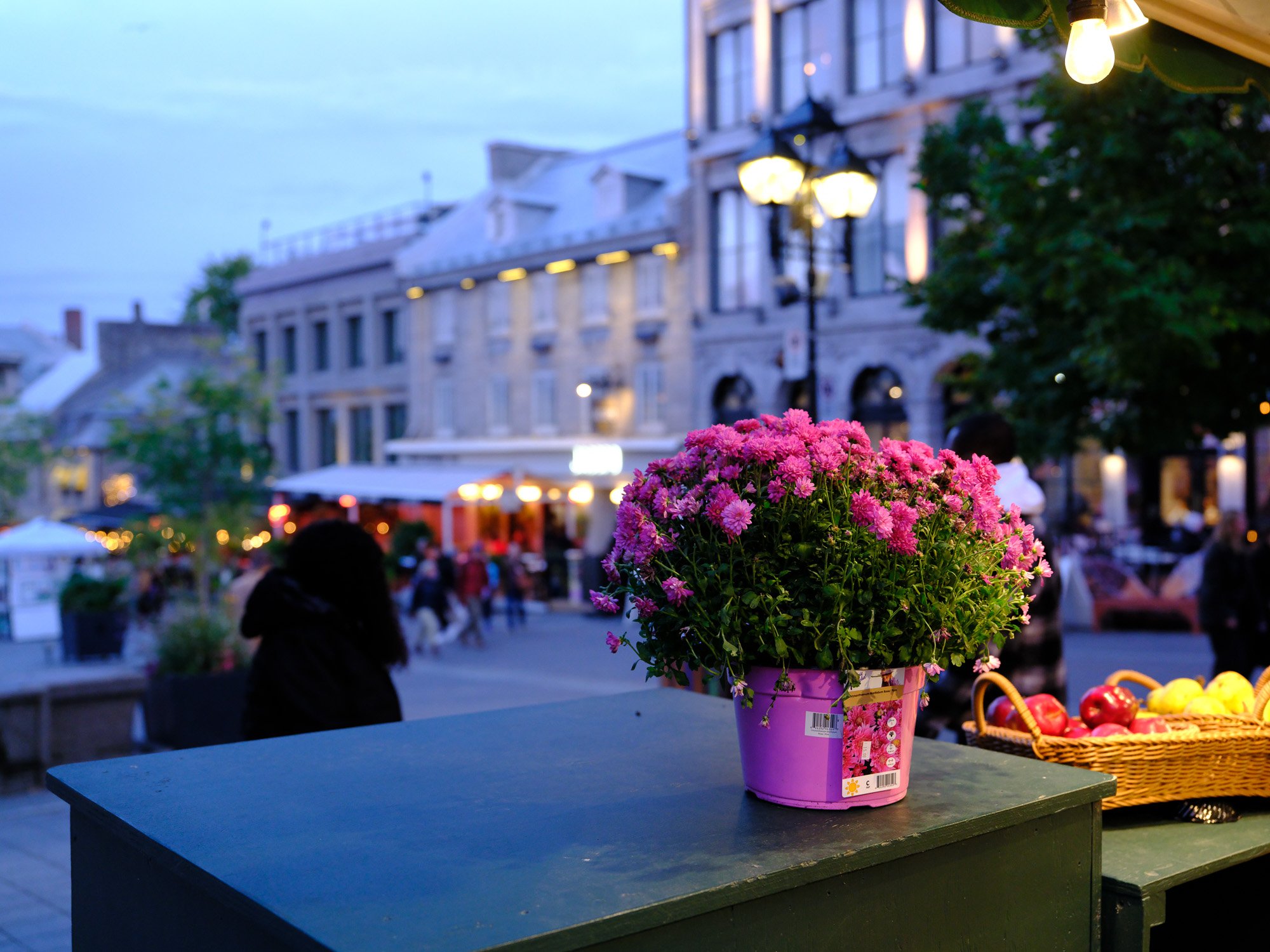
Some of the most interesting frames from Old Montreal came from slowing down and noticing the smaller things — a bicycle with a green crate leaned against a lamp post on a cobblestone street, blue glassware on a café table, a pot of chrysanthemums on a market counter at dusk. The GFX at wider apertures gives you a very pleasing subject separation even on relatively close subjects, and these detail shots give a blog or a photo essay texture and variety that pure architectural or landscape work doesn't always provide on its own.
10. A longer focal length earns its place in the park
The temptation in a park as visually rich as Mont-Royal is to go wide and try to get everything in. But the 45-100mm at the longer end was consistently more useful around Beaver Lake — compressing the layers of colour in the treeline, pulling the pavilion closer across the water, and isolating individual moments like the seagull mid-takeoff from the dock. Wide-angle has its place, but don't leave the longer glass behind.
Where to Stay in Montreal
Montreal offers genuinely good value compared to most major North American cities, and the range of accommodation is solid at every budget level. Location matters here — Old Montreal puts you closest to the historic photography locations and the evening atmosphere of Place Jacques-Cartier, but tends to command a premium. Downtown is a sensible middle ground for price and access. The Plateau-Mont-Royal neighbourhood is worth considering if you want a more local feel and don't mind a short metro ride to the main attractions. All hotels below are bookable on Klook.
Luxury — CAD $350 and above per night
Four Seasons Hotel Montreal is the obvious choice at the top end — spacious, contemporary rooms with floor-to-ceiling windows, an excellent location near the Museum of Fine Arts in the Golden Square Mile, and the kind of service that makes you briefly feel like the camera gear was a sound investment after all. For something with more character, Hotel St. Paul — a member of Design Hotels — is a beautifully maintained boutique property right in Old Montreal, five minutes' walk from Notre-Dame Basilica and Place d'Armes. Large, light-filled rooms, a fireplace, spa and a 4.2 rating on Klook. Ideal if you're shooting the old quarter at dawn and want to be back for breakfast without getting in a taxi.
For the best location in Old Montreal relative to the waterfront, Auberge du Vieux-Port is the only hotel on Rue de la Commune facing the St. Lawrence River — exposed stone walls, wooden beams, a rooftop terrace and steps from Place Jacques-Cartier. It's the kind of place that feels appropriate for a photography trip.
Mid-Range — CAD $150–300 per night
Holiday Inn Hotel & Suites Montreal Centre-Ville Ouest by IHG is a reliable, well-located option in the downtown core — comfortable rooms, good transport links and a price point that leaves budget for the poutine. Consistently well reviewed and a sensible base if you're covering multiple locations across the city, as we were. This was my choice for this trip.
Budget — Under CAD $150 per night
LeLux Hotel is a compact, well-priced option in Montreal that comes up consistently on Klook for budget-conscious travellers who don't want to compromise too much on comfort or location.
Book Flights to Montreal
A practical note for photographers specifically — wherever you stay, factor in parking if you're driving between locations as we were. Old Montreal in particular has limited and expensive parking, and as Day 1 demonstrated, circling the neighbourhood looking for a space is time you could be spending shooting. Several of the downtown hotels have underground parking available; worth checking at the time of booking.
Shot in fall 2024, when the leaves were showing off, and my gear's weather sealing got a proper workout.
