Vancouver Waterfront in Late Spring: A Photo Essay
Vancouver, British Columbia — May 2026
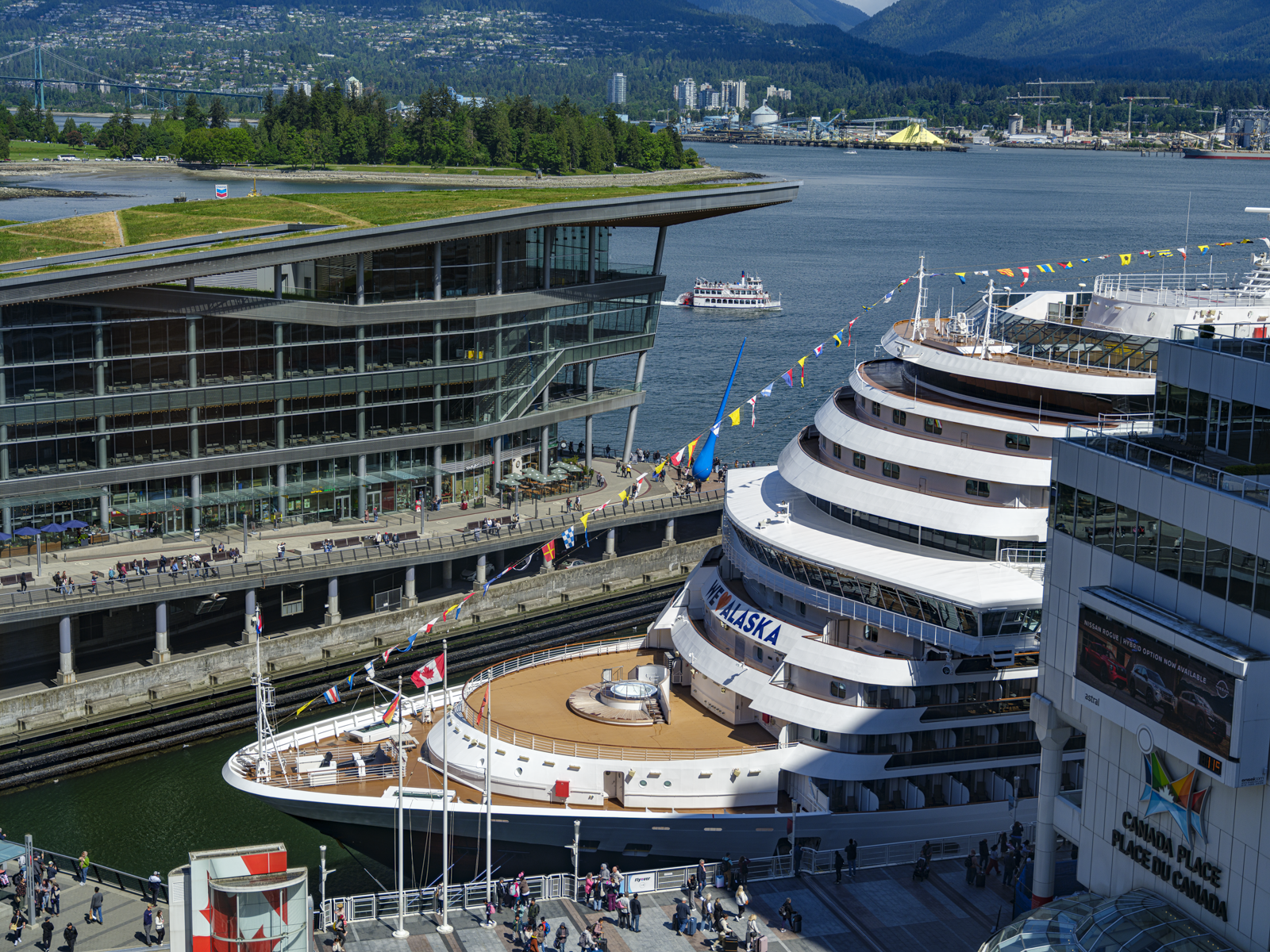
Scene at Canada Place, Vancouver Waterfront
I lived in Vancouver for just over two years — August 2023 to November 2025 — and in all that time I felt I didn’t spend enough time properly photographing the waterfront.
This is less strange than it sounds. We lived in East Vancouver, out on Knight Street, far from the postcard version of the city. Our Vancouver was Commercial Drive and Main Street, the working neighbourhoods east of downtown, where the city gets on with itself without much interest in being admired. I shot elsewhere — the mountains, the interior, trips further afield — but Burrard Inlet, Canada Place, the seaplane terminal a few kilometres from our front door: somehow, I never made the time.
Then we left. November 2025, six months before this essay was made.
I came back in May 2026 for my daughter's graduation from Emily Carr University of Art and Design — one of Canada's great art schools, sitting on the eastern edge of False Creek, a short walk from the water. A photographer's daughter, graduating in art and design. I am aware of the symmetry. She would be the first to point it out.
Between the ceremonies and the celebrations, I finally did what I should have done while I lived here. I went to the waterfront. I went back several times, at different hours, in different weather. And I made the photographs I had been quietly owing this city for two years.
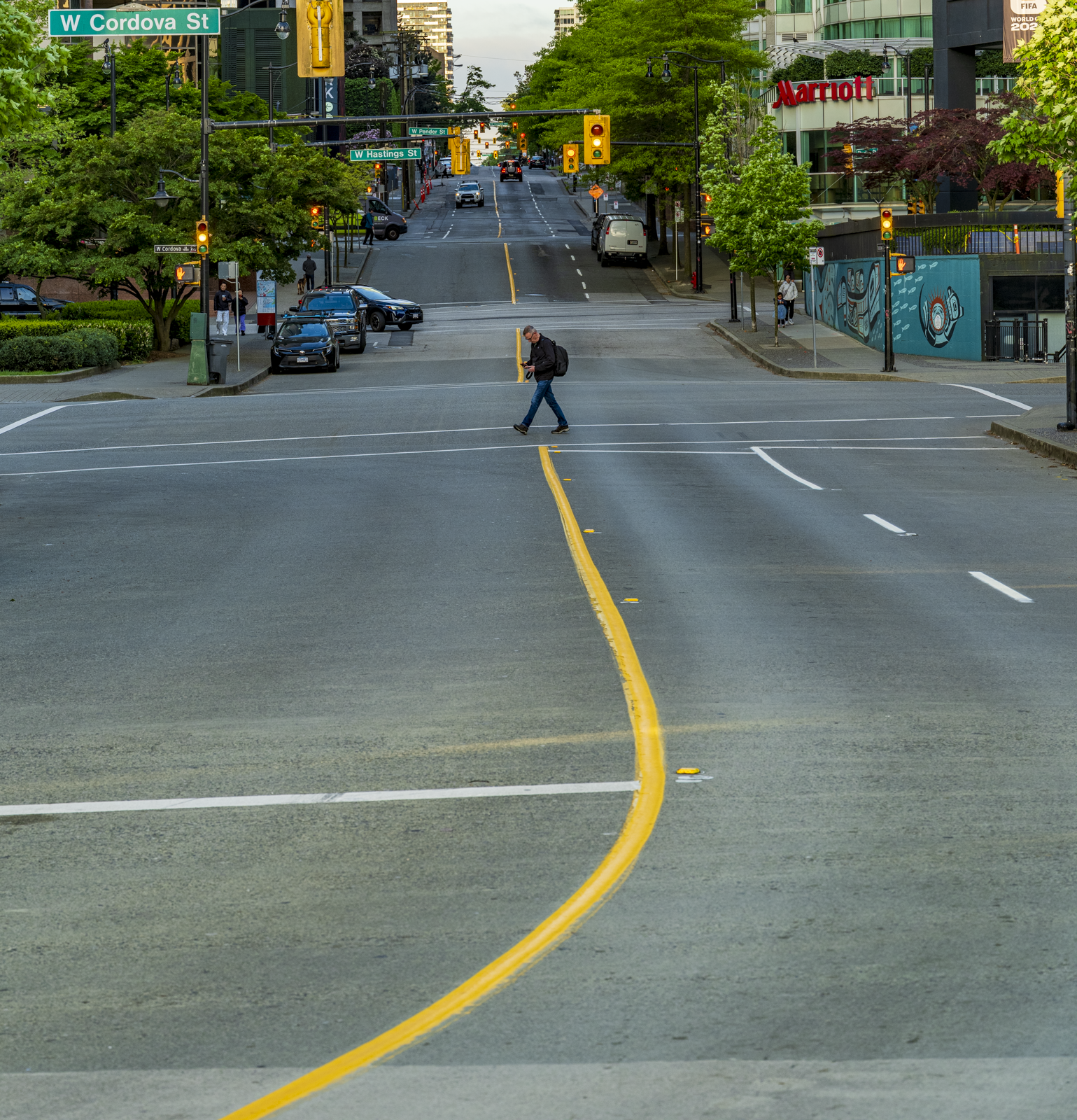
Before the City Wakes
The first image in the sequence was not taken at the water at all. It was taken in the street, early — earlier than most of the city — walking down toward the waterfront from somewhere behind downtown.
I looked down from a slight elevation at the junction of Cordova Street and saw this: the road almost empty, a single figure crossing, the trees in their full May green along both sides, and a sweeping yellow road marking curving through the entire lower frame like a brushstroke. The traffic lights glow in the middle distance. The street rises toward the rest of the city.
The figure is a photographer — backpack on, camera in hand. I didn't realise until I was editing that I had photographed myself.
It felt like an appropriate way to begin. Returning to a familiar city before it has properly started, moving through it on my own terms for the first time.
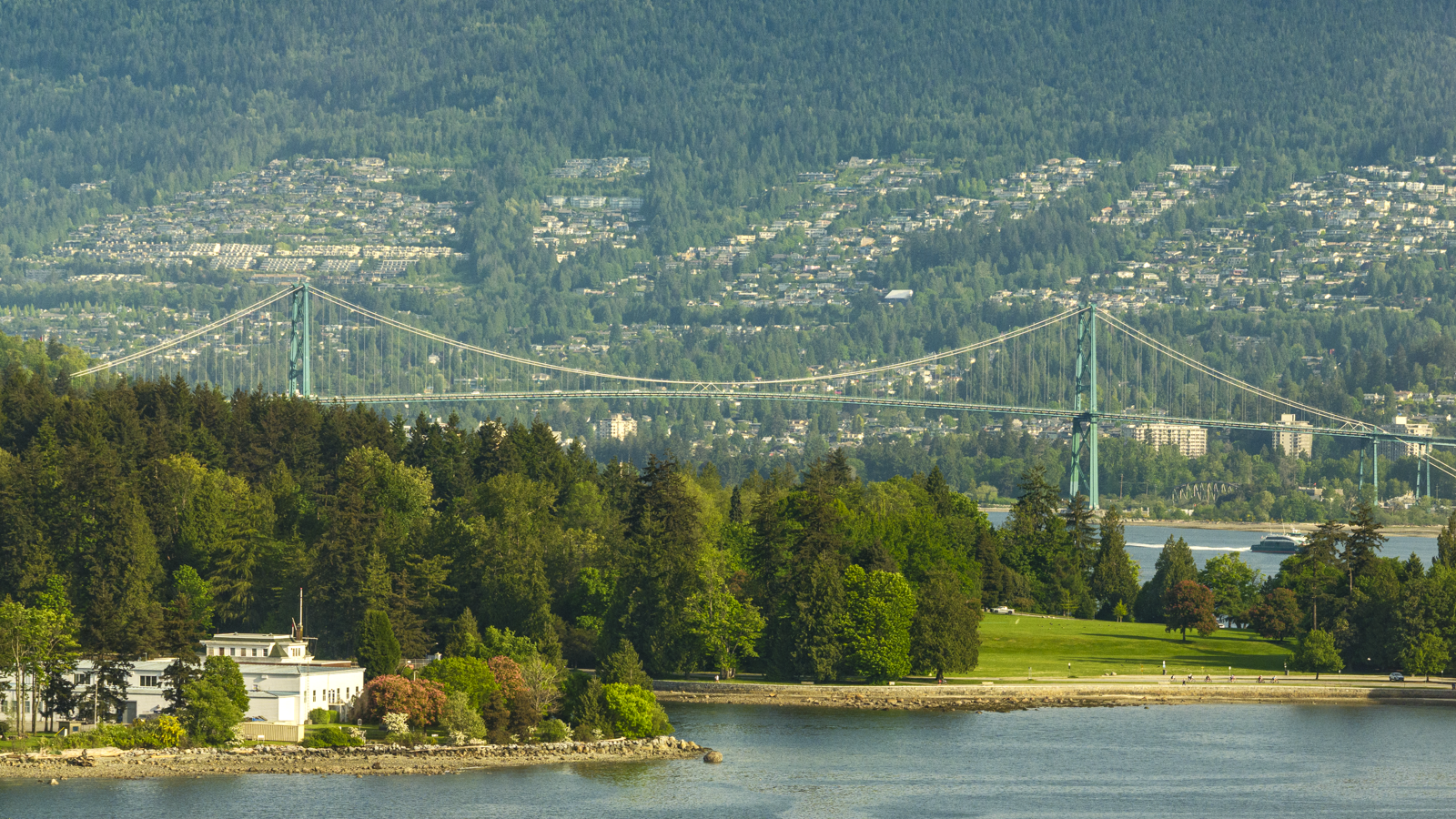
The Lions Gate Bridge at Morning
had seen the Lions Gate Bridge hundreds of times from the car, from the bus, through the window of everyday life in the city. I had never stopped to photograph it properly.
From elevation, looking west in warm morning light, Stanley Park fills the lower half of the frame in every shade of green imaginable — the harbour master's white building nestled at the water's edge, the trees rising behind it in their May peak. The bridge emerges from the forest in its distinctive teal, its cables catching the early light. Behind it, the North Shore forest climbs all the way to the cloud line.
I had lived two years and three months in this city and never made this photograph. Standing here in May, six months after leaving, I understood something about proximity that I should have understood sooner.
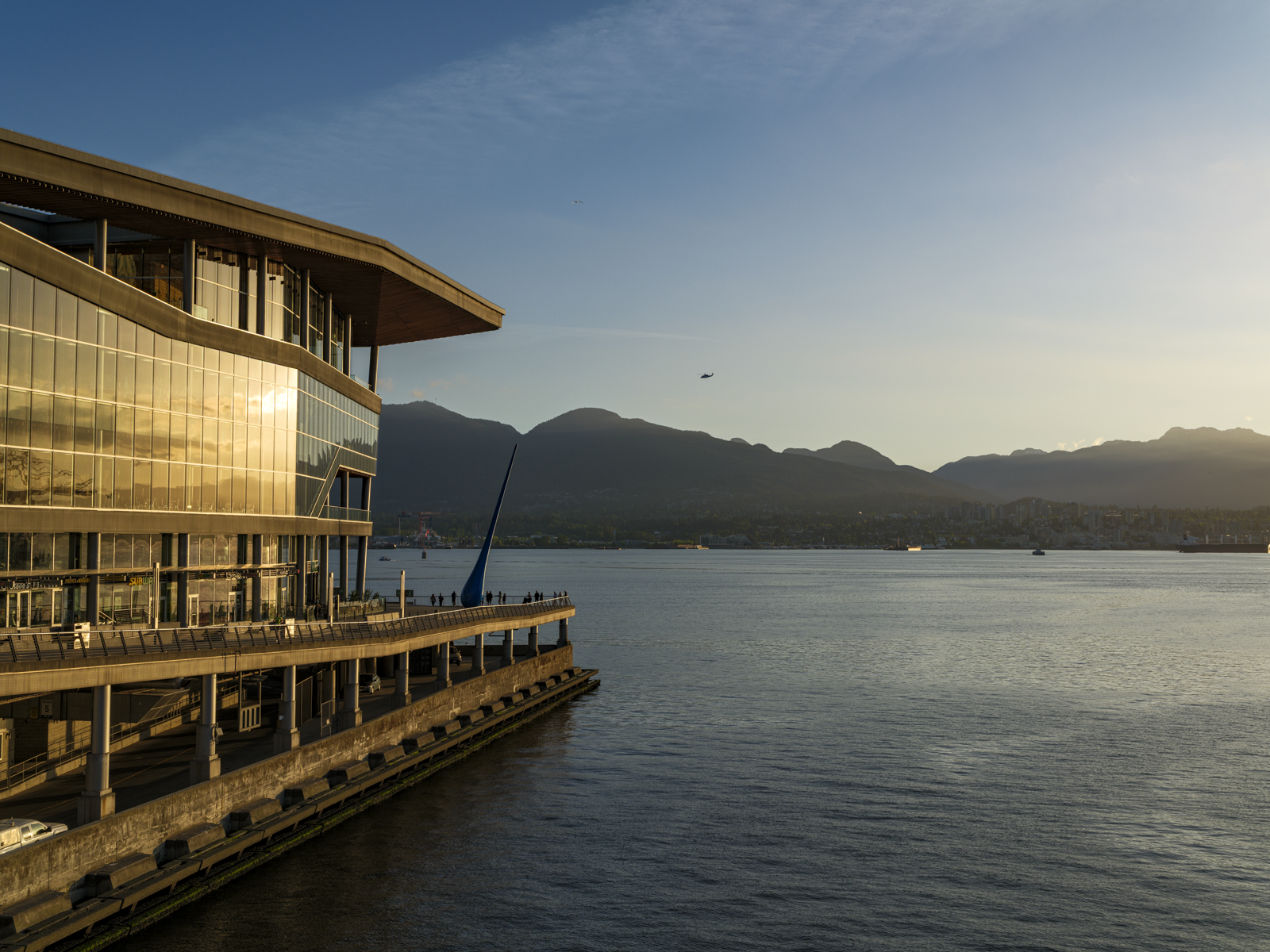
The Convention Center at First Light
The Convention Centre was one of those buildings I had walked past countless times without ever stopping to look at properly — the way you stop noticing things that are simply part of the route between places.
In the first light of a May morning, it became something else entirely. The glass facade turned to gold. The angular geometry caught the low sun and held it. The blue needle sculpture on the waterfront promenade below pointed skyward against the silhouetted North Shore mountains. And in the upper right corner of the frame, almost invisible, a helicopter moved through the haze.
I did not notice the helicopter until I was editing. It became my favourite detail in the image — a tiny moving thing in all that held stillness. The city continues, indifferent to the light falling on it.
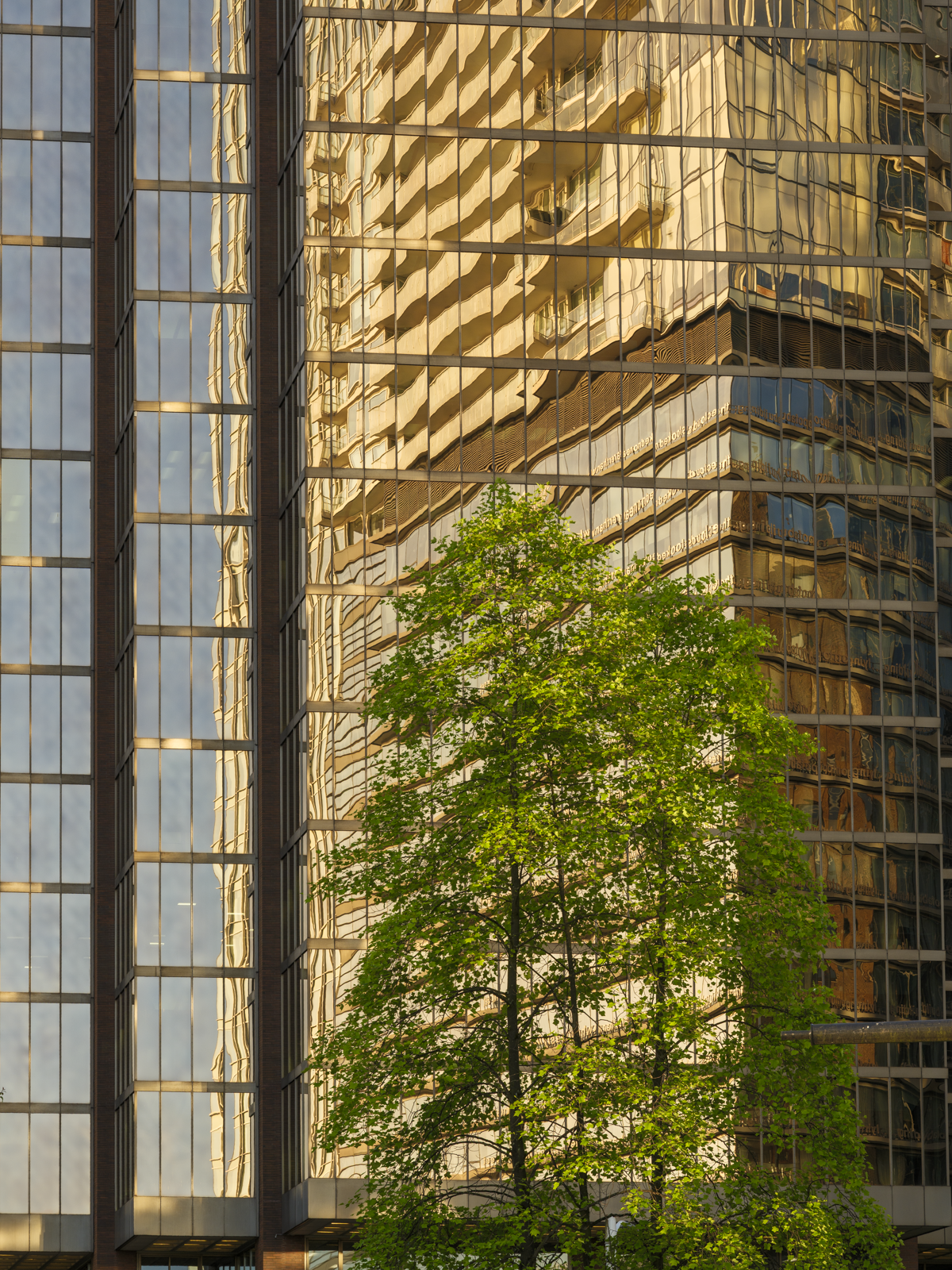
The Glass Tree
A block from the waterfront, early in the morning. The low sun had caught a glass tower and thrown the distorted reflection of the building opposite across its facade in rippling gold. At its base, entirely at odds with the scale above it, a single spring tree in full fresh leaf.
Vancouver's downtown is saturated with glass, and glass in May light does remarkable things. I had walked past buildings like this on the way to appointments, the way you walk past things when a city is still a backdrop rather than a subject. Now it was a subject. The difference, it turns out, is simply attention. Which is why I love visiting new places for my photography.
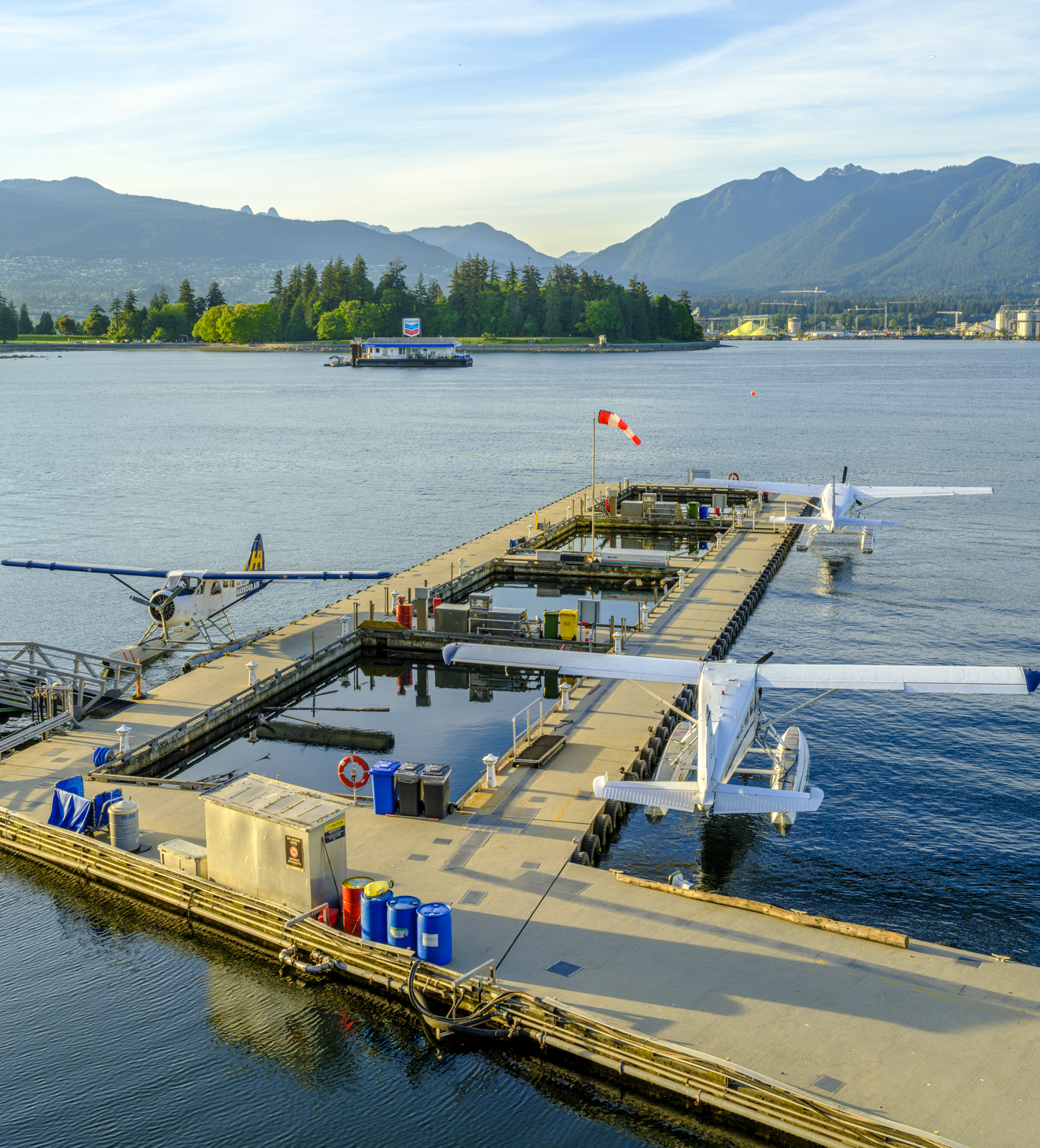
The Harbour Air seaplane terminal was one of the specific things I had always meant to photograph while I lived here and never had. From Knight Street it felt like another world — the working waterfront, the float planes lifting off Burrard Inlet at all hours, the particular Vancouver infrastructure that still strikes newcomers as quietly extraordinary.
I photographed it twice, in completely different light.
The first was early, in warm morning clarity — the dock stretching into the flat blue inlet, two floatplanes at the far end, the red windsock bright against the pale sky. Stanley Park's wooded promontory sits across the water, and the North Shore mountains are sharp and clean behind it, their upper peaks still holding snow. A purposeful, unhurried image. A working place before work has properly started.
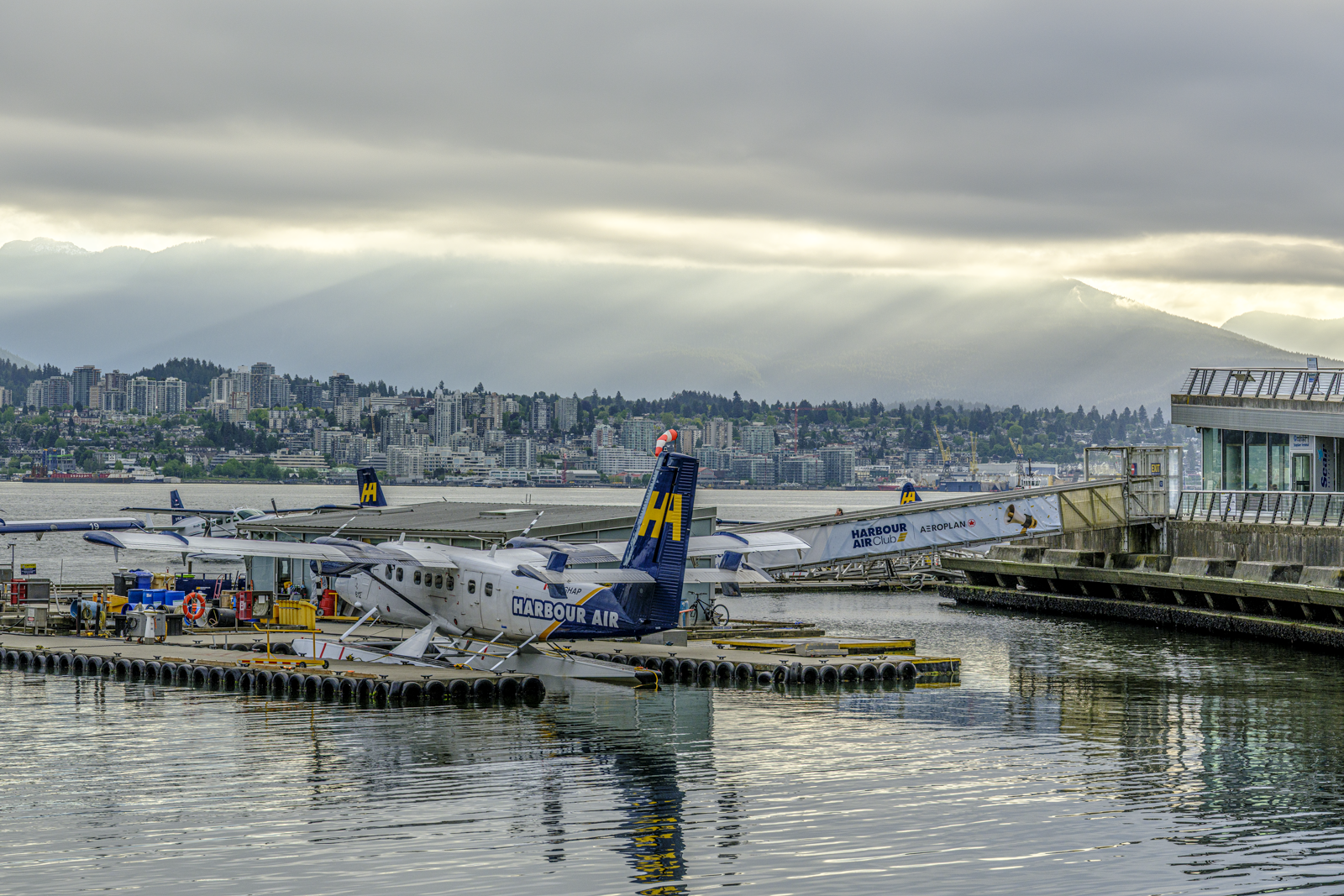
Vancouver, A City where float planes are a major mode of transport
The second was under heavy cloud, crepuscular rays breaking through in dramatic diagonal shafts across the mountains and inlet, North Vancouver spread below them. The Harbour Air fleet at the dock, their blue and yellow livery the only strong colour in a frame otherwise silver and grey. This is the Vancouver I actually lived in — the overcast city, the dramatic sky, the mountains doing something spectacular behind the cloud. I had forgotten how much I loved that light.
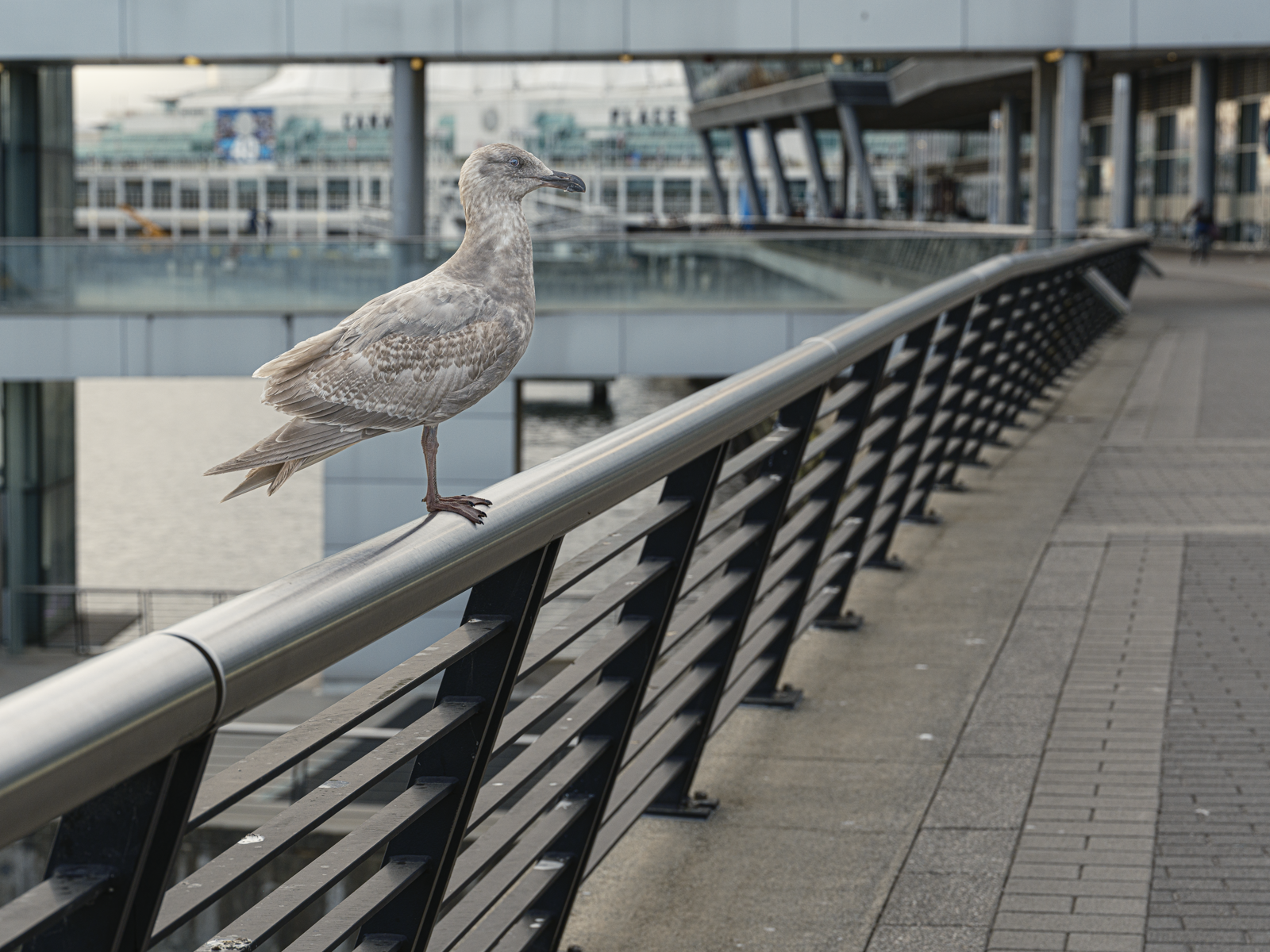
The Gull Who Owned the Promenade
The gull was on the railing when I arrived and showed no interest in moving. I got close, dropped to its eye level, and let the Canada Place terminal go soft behind it.
The railing recedes into the background in clean parallel lines. The blur of the terminal building and water sits beyond. The gull is simply there — indifferent, utterly at home, owning the waterfront in a way that the cruise ships and the architecture and the morning crowds do not.
Dramatic Light on the North Shore
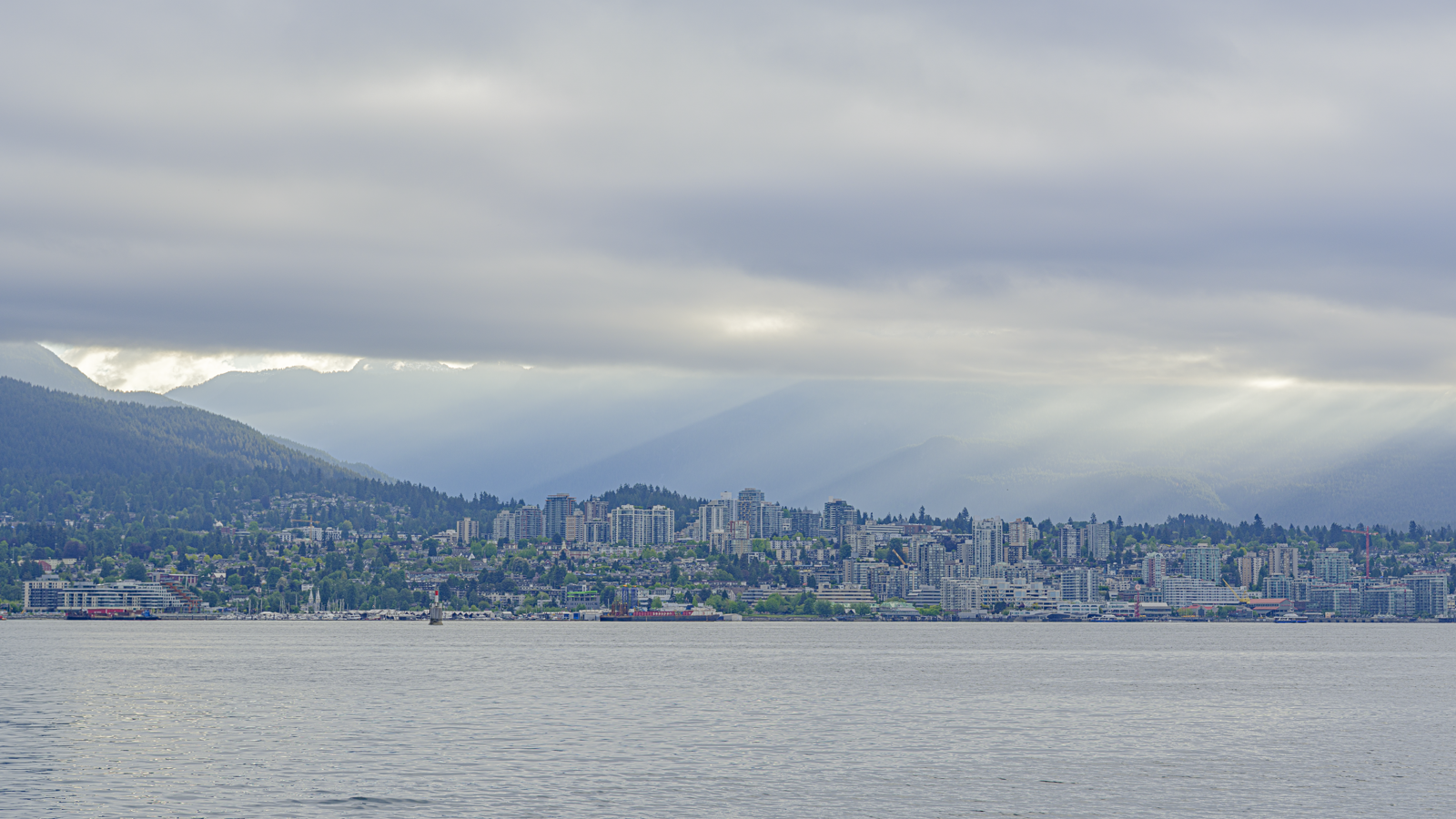
There is a particular quality of light that belongs almost exclusively to the Pacific Northwest — the kind that happens when heavy cloud cover fractures over a mountain range and sends shafts of light down in distinct, dramatic diagonals across everything below. I had lived under this sky for over two years. I knew this light the way you know the sound of rain on a specific roof.
Looking north across Burrard Inlet on a grey May morning, the cloud suddenly broke over the North Shore mountains in exactly this way — rays falling across the upper slopes, across North Vancouver's city spread at the mountain's base, across the inlet itself, the water catching the light from below and throwing it back diffused and silver. The whole scene lasted minutes. Perhaps less.
This is not a light you can reliably plan for or wait for. You can only be in the right place when the sky decides to do what it wants. After two years of driving past this view on the way to somewhere else, I was finally standing still when it mattered.
Where the geometry ends, and the city begins to breathe
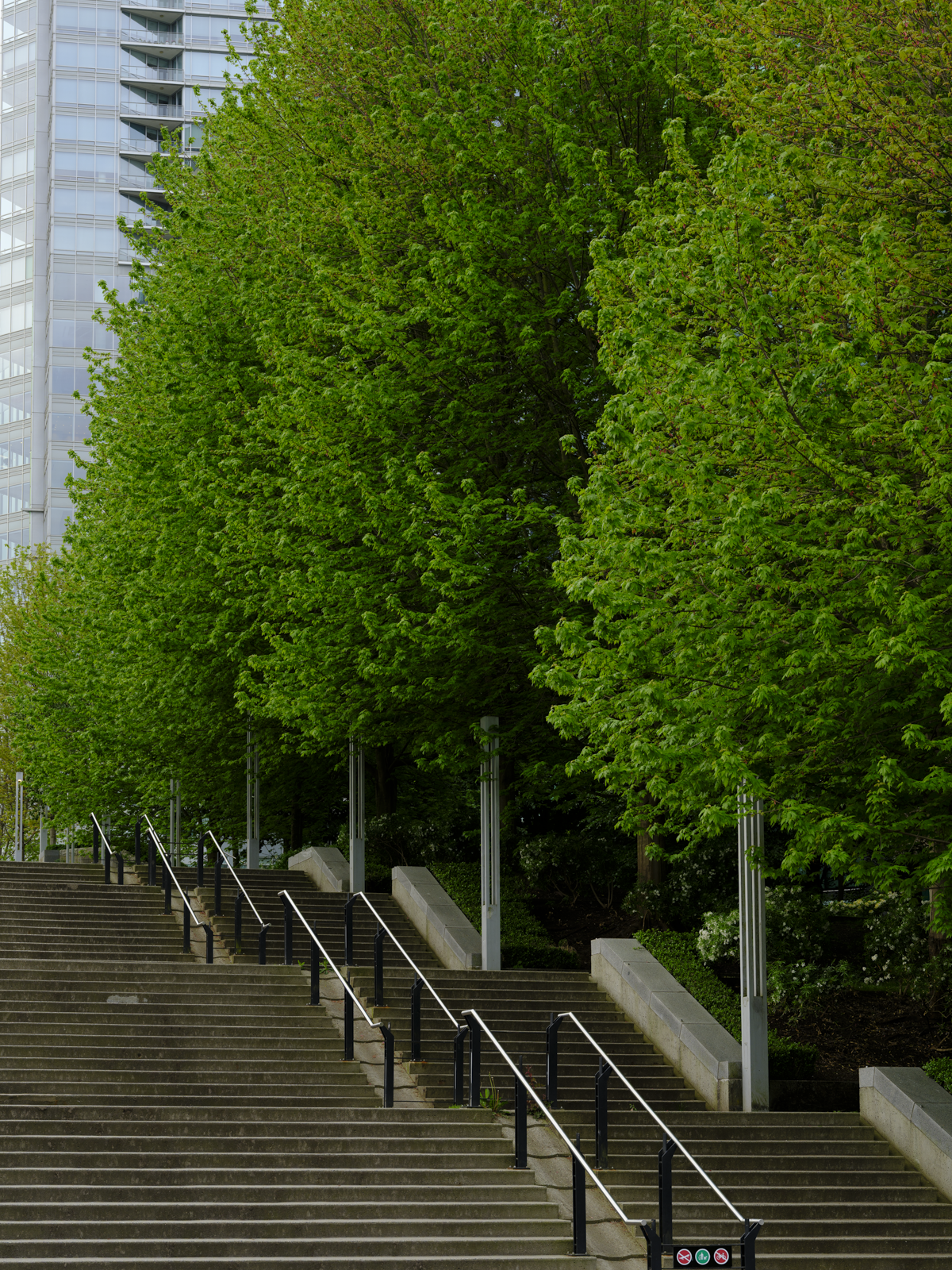
This image is about pattern more than place.
The staircase draws you in immediately — wide stone steps rising in a clean, receding rhythm, the parallel lines of the black railings multiplying as they climb, each one a slightly different angle from the last, creating a layered geometric structure that pulls the eye upward and inward simultaneously. It is the kind of composition that reveals itself slowly. You notice the steps first, then the railings, then the way they work together as a system of converging lines.
And then the trees take over. At the top of the staircase the geometry dissolves entirely into canopy — a dense, unbroken wall of May-green that fills the upper two thirds of the frame with a texture so rich it almost reads as abstract. The fresh spring growth catches the light unevenly, some leaves luminous, others in deep shadow, the whole mass alive with a depth that flat summer green never quite achieves. A single tower building is just visible in the upper left corner, its grid of glass panels offering one last geometric echo of the staircase below before the trees swallow everything.
Hard lines giving way to organic ones. The city's insistence on structure, and nature's quiet refusal to honour it.
The Brilliant Lady Comes In
I did not know, when I went down to the waterfront that morning, that anything particular was happening. I had simply gone early, as I had on several mornings, to catch the light before the city filled up.
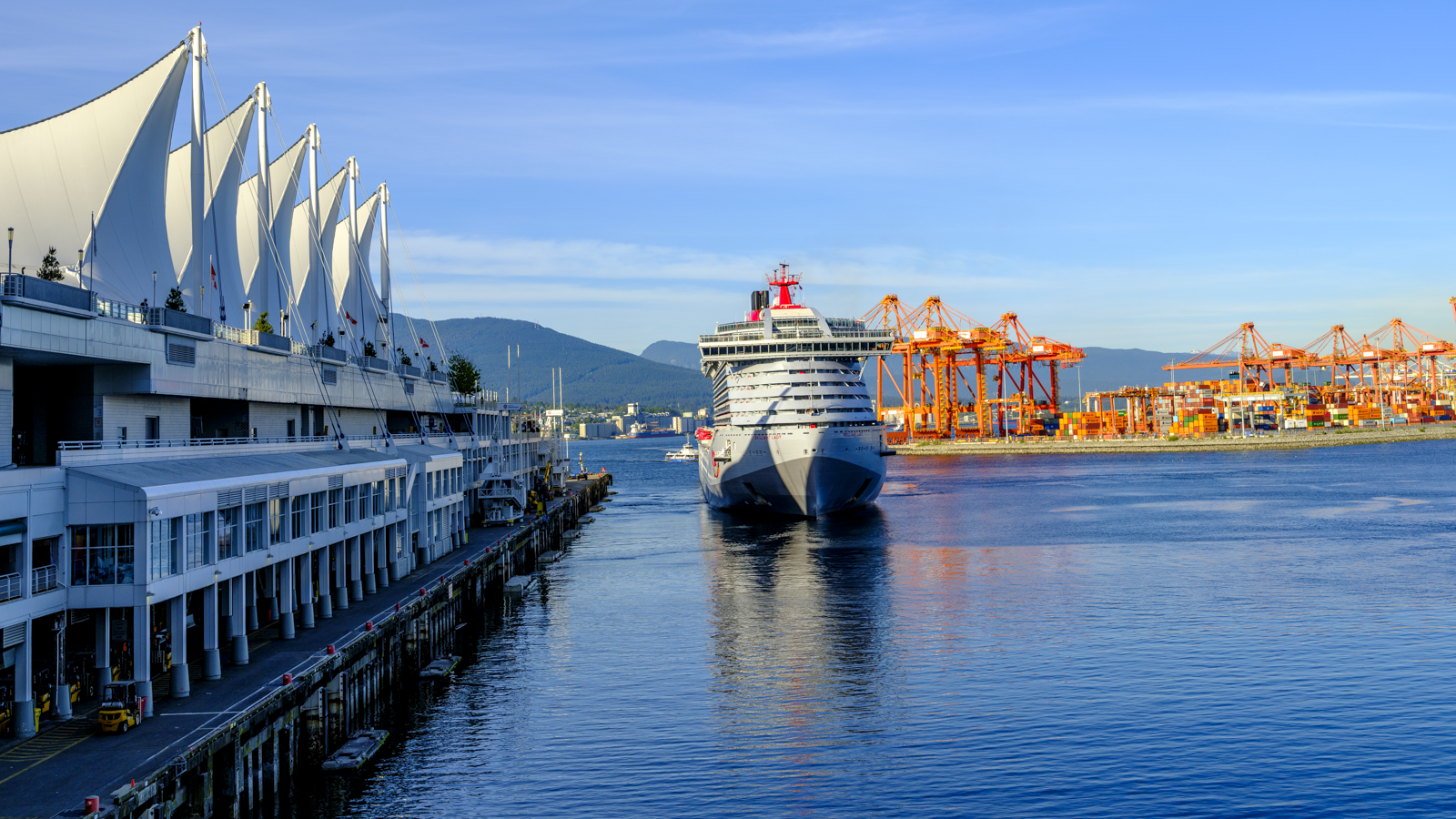
The press were already there. Camera crews, photographers, people with lanyards and purpose — gathered at the waterfront with a focus that told you something significant was arriving. And then it came: the Brilliant Lady, Virgin Voyages' newest ship, making one of her first appearances in Vancouver as part of her inaugural season. She is a striking vessel — that grey hull and bold red funnel entirely distinctive against the white and navy livery of most cruise ships — and she moved through the inlet in the early morning light with the unhurried confidence of something that knows it is being watched.
I was not there on assignment. I had no lanyard. I was a former Vancouver resident with a camera and a free morning, standing among the press corps by accident, photographing the same arrival for entirely different reasons.
The first frame — Canada Place's white sail roof in the left foreground, the Brilliant Lady gliding in from the right, the North Shore mountains behind in the cool blue of early morning — is the more composed, architectural shot. Calm, considered, the water still, the mountains in their full May green.
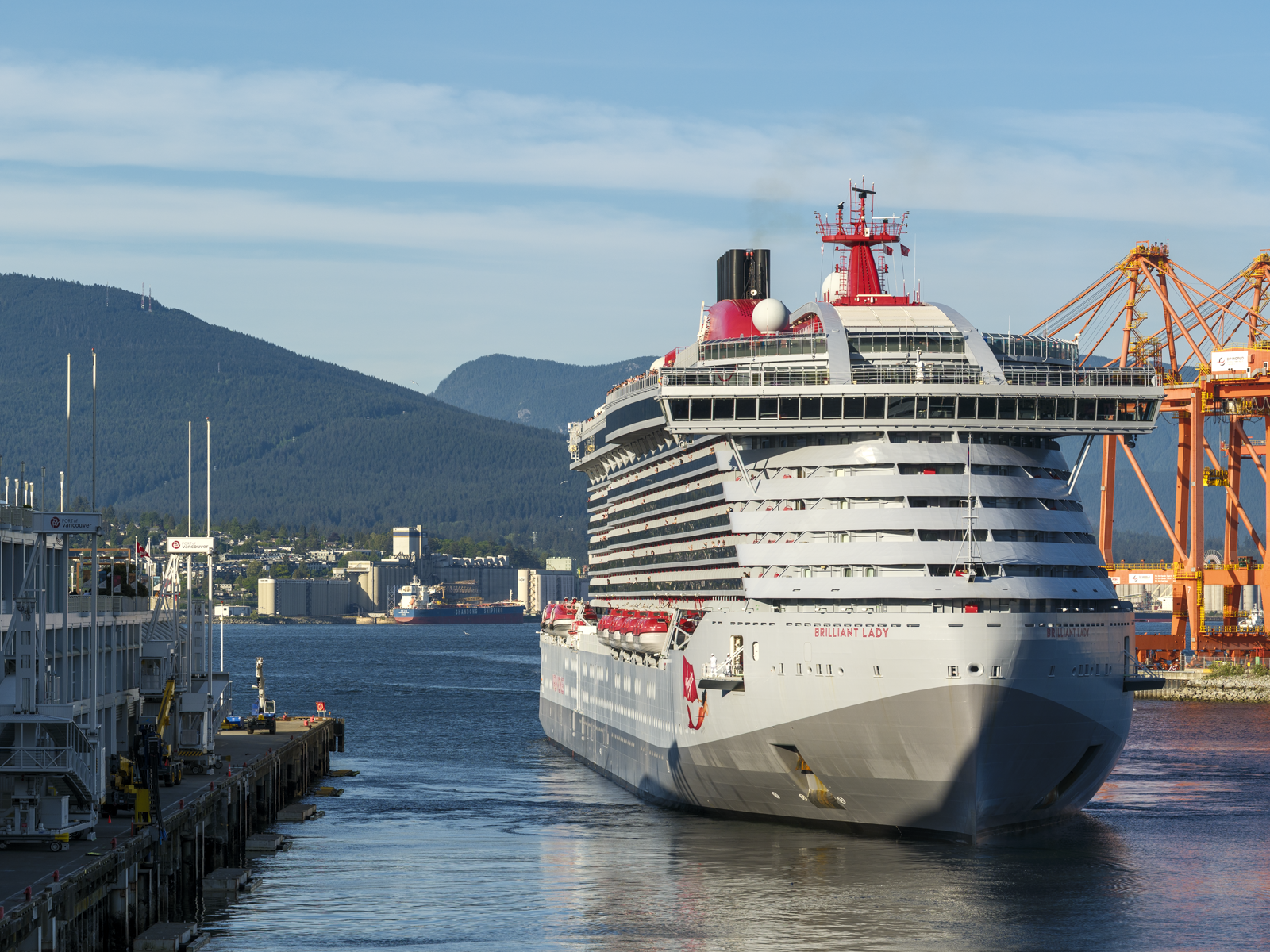
The second is closer and more frontal: the bow filling the right half of the frame, the port's orange container cranes behind her, North Shore mountains completing the backdrop. A frame about scale and industry and the particular quality of first light on a significant morning.
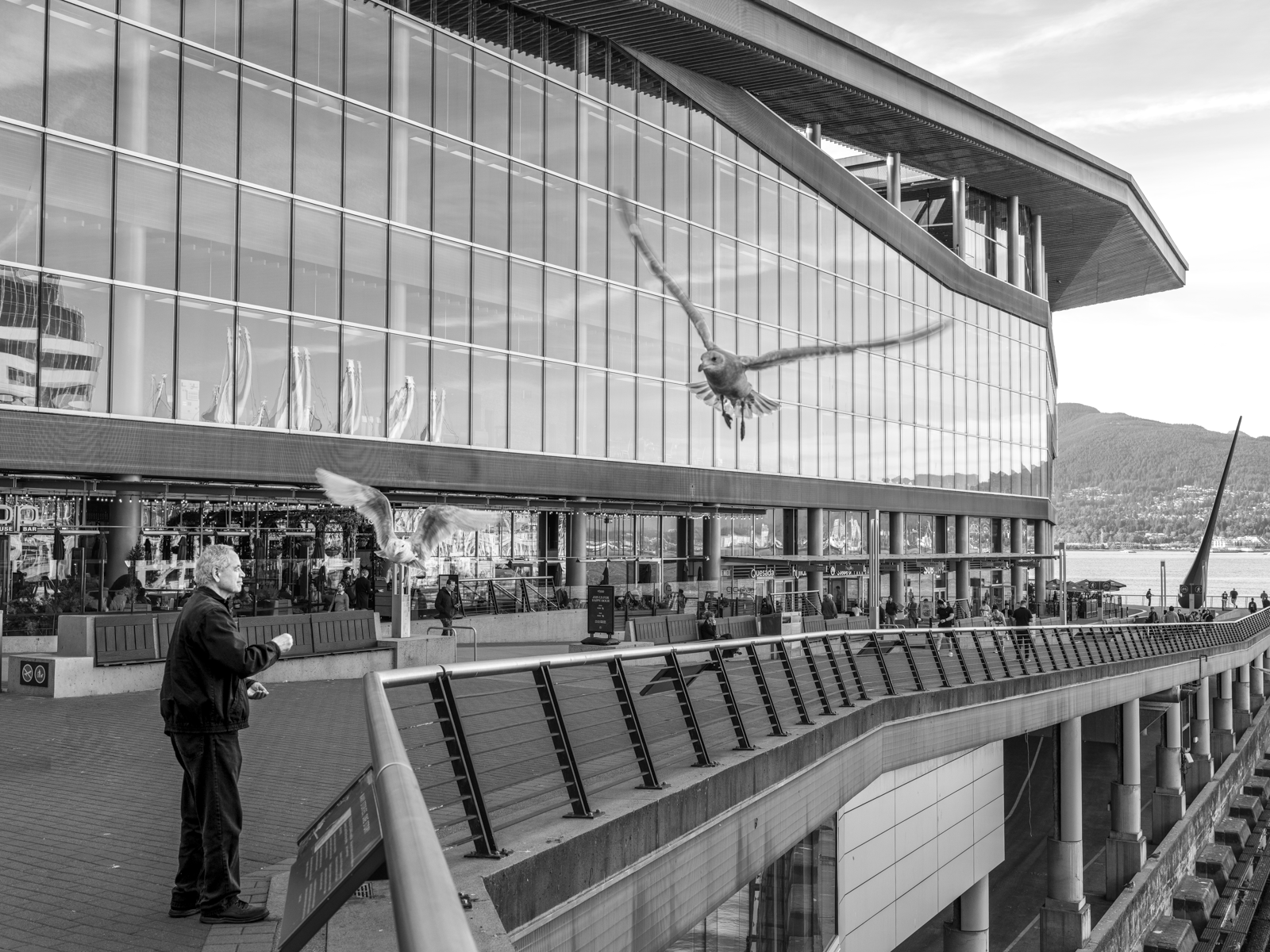
The Man and the Gulls
I converted this to black and white in the edit, and it was immediately right. A man alone on the waterfront promenade, hand extended, two gulls at different points of flight around him. The glass facade of the Convention Centre is in abstract relief behind him. The city moves, indifferently, in the background.
He was there for ten minutes, entirely in his own world, at a pace that the waterfront seems to encourage.
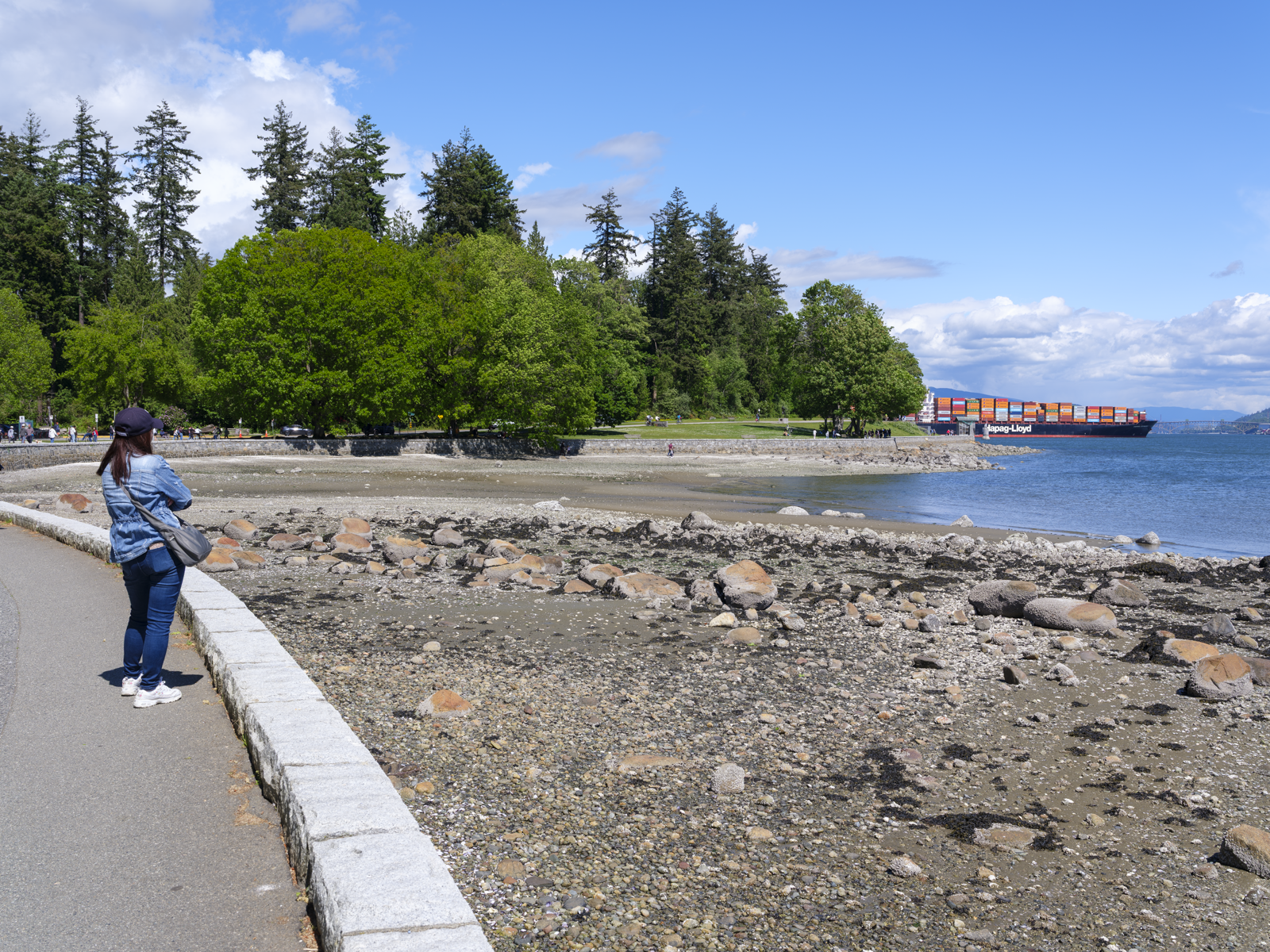
The Seawall Witness
A woman stands at the seawall wall, her back to the camera, watching the Hapag-Lloyd vessel pass in the distance. The tide is out, the rocky beach exposed in the foreground, the rounded boulders and pebbles catching the midday light. Stanley Park's trees rise behind the path — Douglas firs and cedars, the dark permanent green that persists through every season. The ship is small in the frame here, almost incidental, a detail at the edge of someone else's moment.
What I like about this image is what it says about scale and attention. The ship is the same vessel, the same extraordinary size, the same colourful stacked containers. But from here it reads differently — not as the subject, but as the thing being watched. The woman is the subject. Her stillness. The low tide beach. The ordinary afternoon on the seawall that this city offers its residents and visitors without ceremony, every single day.
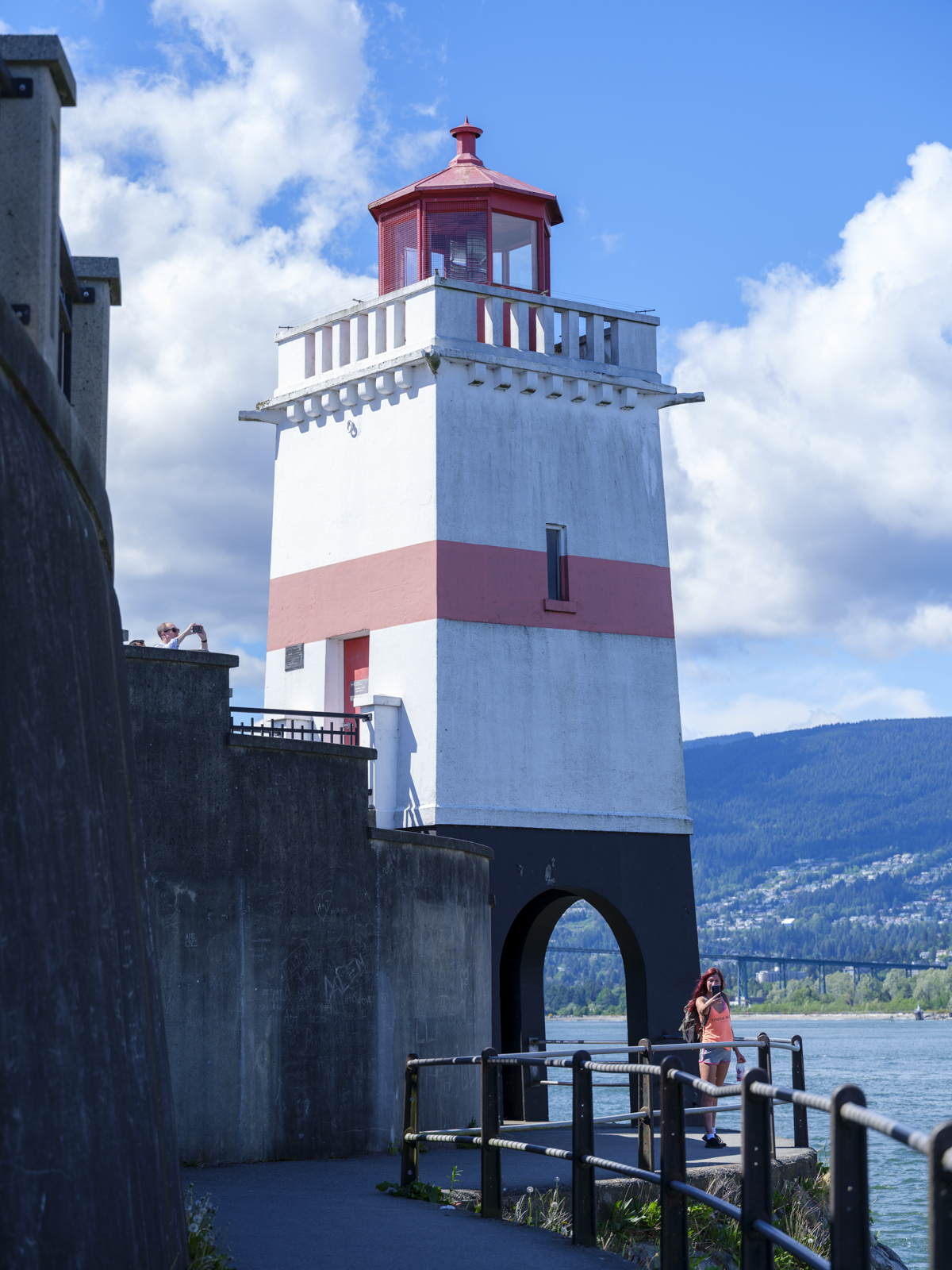
Brockton Point
The Brockton Point Lighthouse has been standing at the eastern tip of Stanley Park since 1914, marking the entrance to the inner harbour. It is one of those structures that everyone who has spent time in Vancouver knows peripherally — visible from the water, from the seawall, from the upper decks of the cruise ships coming in — without most people ever stopping to look at it directly.
Shooting from close in and slightly below, the lighthouse fills the frame against a blue May sky with good cloud. The white tower with its red band and red lantern room has a solidity and a geometry that rewards proximity. The arched passage cut through the base of the structure frames the water and the mountains behind it. A young woman poses near the lighthouse. A tourist on the upper level photographs the view I am looking away from, toward the lighthouse itself.
It is a building that has watched this harbour change beyond all recognition over a century while remaining entirely itself. There is something in that worth a photograph.
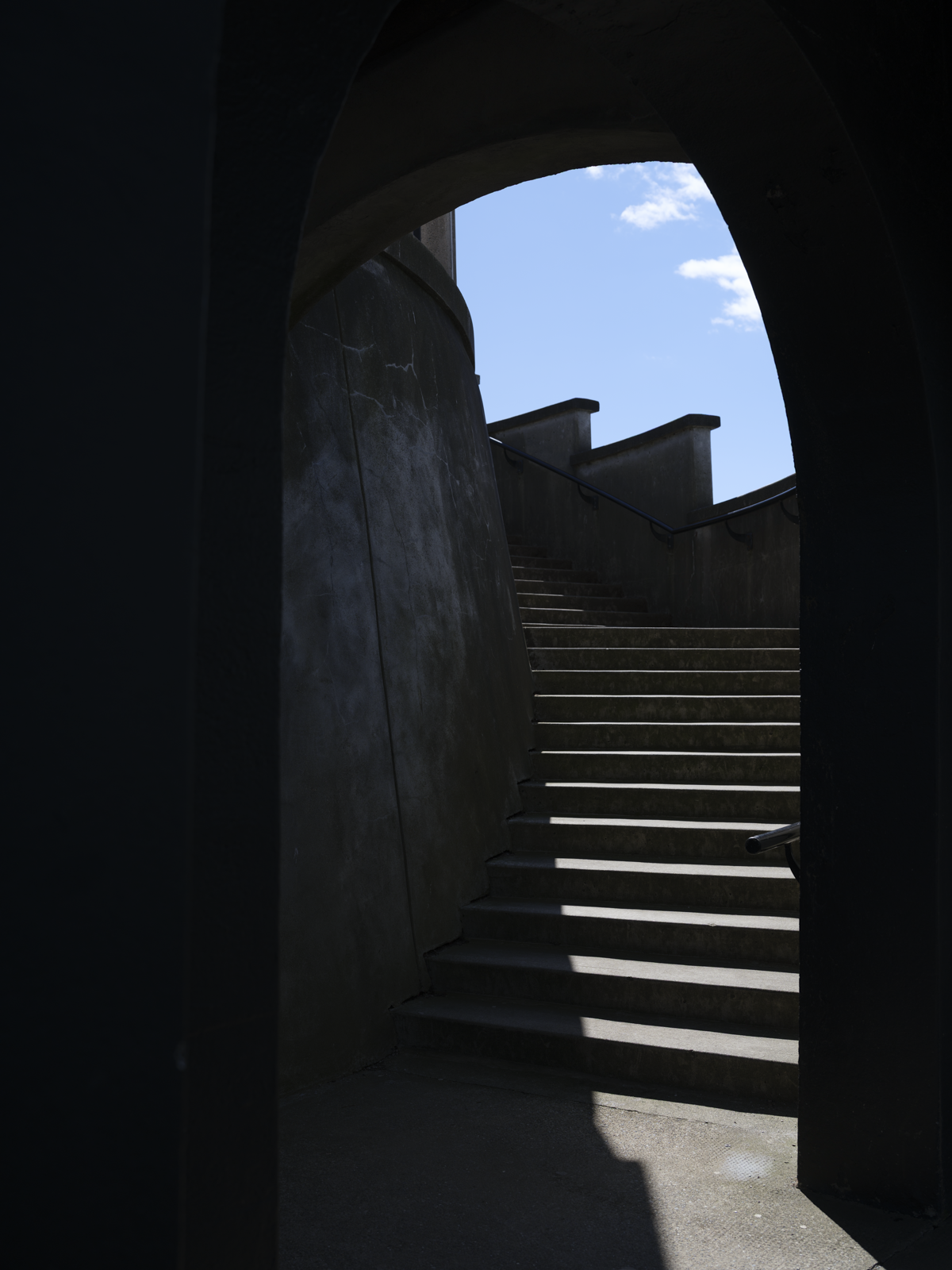
Dark Arch, Blue Sky
I went through the arch and turned around.
This is what was on the other side — deep shadow, the curved stone of the arch filling the left of the frame, a staircase rising in the centre toward a rectangle of blue sky with a single white cloud. The light falls in horizontal stripes across the steps, each tread catching a thin line of brightness before dropping back into shade. The geometry is almost musical — the repeated horizontals of the steps, the curve of the arch, the hard-edged opening of sky at the top.
It is the most purely photographic image in this essay. No harbour, no mountains, no context. Just light and stone and the way a specific quality of midday sun behaves when it enters a confined space from above. I could have been anywhere. I was at the edge of Burrard Inlet on a May afternoon, standing in a lighthouse arch that most people walk through without stopping.
The photograph is about stopping to observe patterns
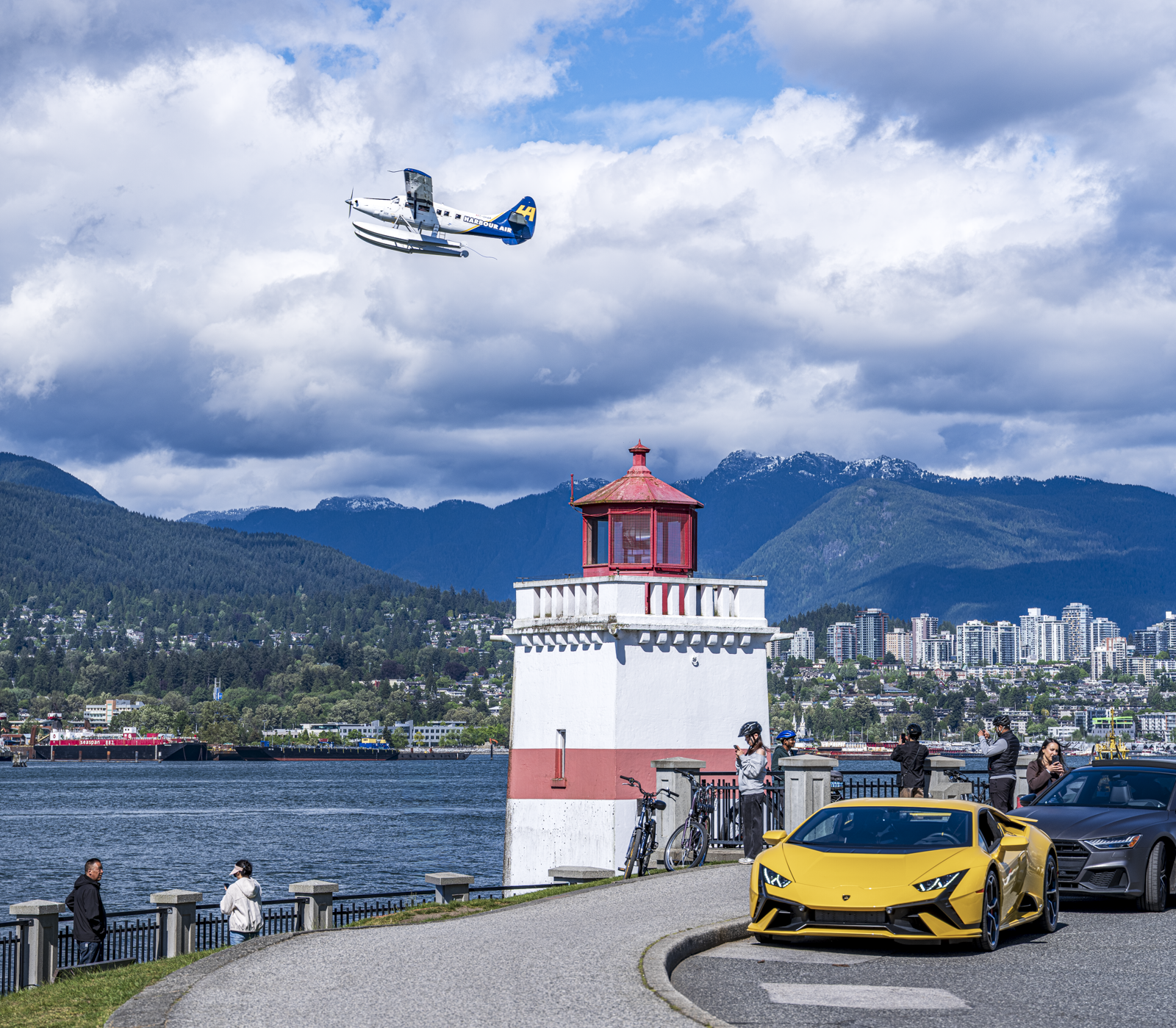
Only in Vancouver
I did not arrange this image. I could not have arranged this image.
The yellow Lamborghini Huracán was simply there — parked on the curved road beside the lighthouse, its driver standing nearby, as if this were a normal place to park a supercar on a Tuesday afternoon. Which, in Vancouver, it apparently is. A Harbour Air floatplane was banking overhead, making its approach to the terminal, its blue and yellow livery vivid against the cloud. The lighthouse stood between them. North Vancouver and the mountains completed the backdrop. People on bikes and on foot moved through the scene with complete indifference to the composition assembling itself around them.
I raised the camera and had perhaps five seconds before the plane moved out of the frame.
Some cities make photographs easy by being visually coherent — everything in the same register, the same palette, the same era. Vancouver is not one of those cities. It throws a century-old lighthouse, a yellow supercar, a floatplane, a mountain range, and a working harbour into the same frame and expects you to make sense of it. This image is my attempt. I am not sure I have fully succeeded. I am also not sure that matters.
It is the most Vancouver photograph I have made on this trip
On Returning
Six months is long enough to miss a place and short enough that it still feels like yours. The streets are familiar. The light is familiar — that particular Pacific Northwest quality, cool and directional and endlessly changeable — even when you have been living somewhere else entirely. You fall back into the city's rhythms without thinking about it.
What is different, coming back, is that you are no longer in it. You are looking at it. And looking, it turns out, is something you can only do properly from a certain distance.
These images are what I owed the city. I'm glad I finally paid it.
